A courtyard fountain in La Jolla or Rancho Santa Fe is one of those features that looks effortless, until it isn’t. The water turns green, the nozzles start dribbling instead of arching, and a thin white crust creeps up the basin walls. Fountains are low-maintenance in theory but high-attention in practice, and San Diego’s climate makes every one of those problems arrive faster than owners expect.

Why fountains clog and cloud faster than pools
A backyard pool holds tens of thousands of gallons. A courtyard fountain might hold 50. That difference in water volume is everything.
In a pool, a dose of chlorine dilutes across a large body of water and holds for days. In a fountain basin, the same concentration either spikes and etches the stone finish or burns off within hours under direct sun. Getting the chemistry right in a small vessel requires more frequent attention, not less.
Evaporation compounds the problem. San Diego averages just under 11 inches of rain per year, and summer humidity stays low. A decorative fountain loses water fast, sometimes an inch or more per week in July and August. As water evaporates, dissolved minerals stay behind and concentrate. The chemistry drifts, and the conditions for algae and scale tip in the wrong direction.
Debris loading is another factor. A pool has a skimmer drawing surface leaves and dust toward a filter basket. Most residential fountains don’t. Dust, pollen, bird droppings, and windblown debris settle directly into the basin and decompose. That organic load fuels algae and clouds the water faster than anything else.
The bottom line: fountains aren’t simpler than pools. They’re just smaller, which means their problems escalate more quickly.
Calcium and algae in water features: the San Diego problem
San Diego’s tap water is some of the hardest in California. The San Diego County Water Authority reports hardness levels that often run above 300 parts per million depending on the source blend reaching your neighborhood. For pools, that means calcium deposits on tile lines. For fountains, it means the entire basin, including pumps, nozzles, and decorative stone, gets a mineral coating in a matter of weeks.
We’ve written about this in detail for pool owners dealing with hard water scaling, and the same chemistry applies to fountains, just in a more concentrated form.
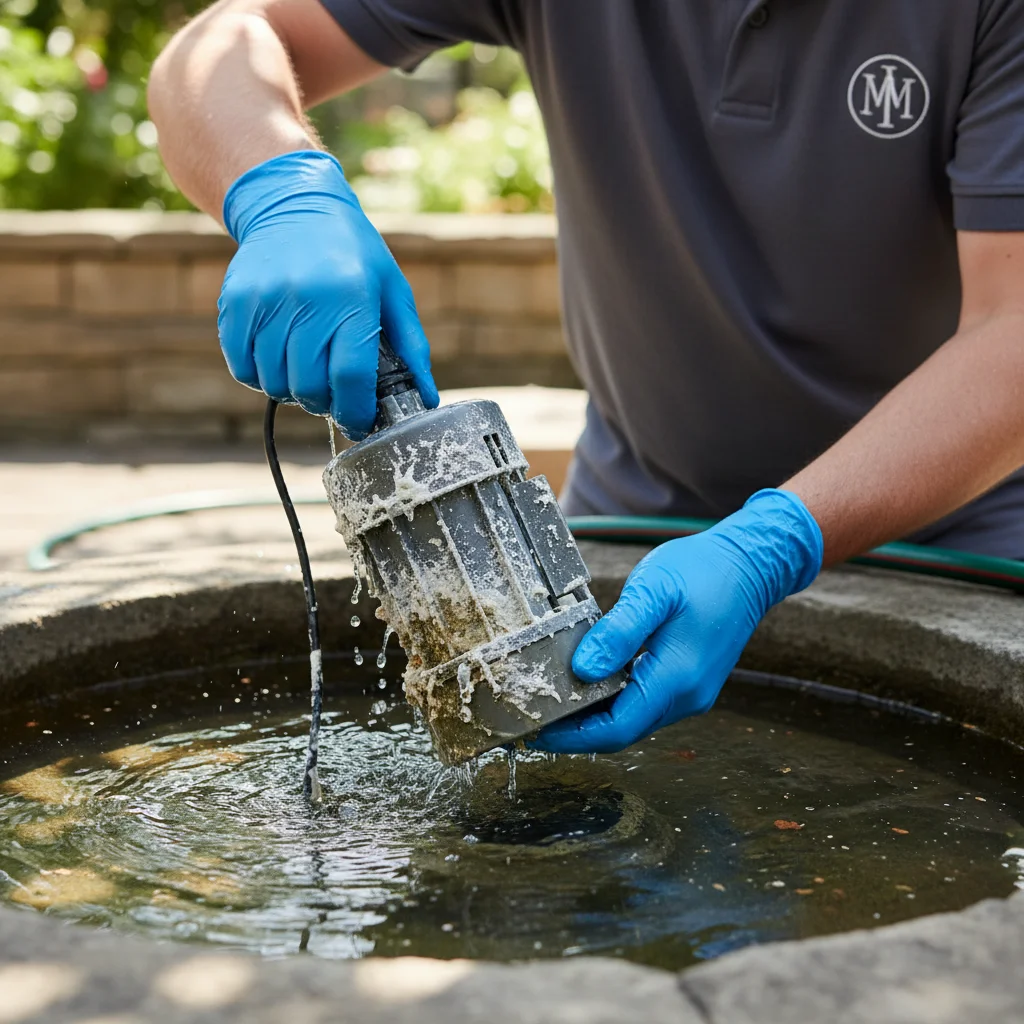
Calcium scale on fountain surfaces isn’t just cosmetic. It narrows nozzle bores, which reduces flow and puts backpressure on the pump. It coats the impeller, which reduces efficiency and accelerates wear. On porous stone, travertine and Cantera are common in Rancho Santa Fe and Coronado courtyard fountains, scale seeps into the material and becomes progressively harder to remove without acid treatment.
Algae in San Diego fountains is primarily a green water algae problem. The shallow basin, high sun exposure, and fluctuating chemistry create ideal conditions. Once algae establishes a biofilm on the basin walls or pump housing, routine sanitizer alone won’t clear it. You need a physical scrub, a proper algaecide treatment, and often a drain-and-clean to fully reset the water.
The good news: both problems are preventable with consistent monthly service. They become expensive only when they’re ignored.
Pump, nozzle, and basin maintenance schedule
A well-maintained fountain runs on a predictable rhythm. Here’s how we think about it.
Weekly (owner-level tasks)
Top off the water level. An inch of drop changes the head pressure on the pump and can cause it to cavitate, pulling air instead of water, which damages the impeller over time. Check that the pump is running and that all nozzles are producing the expected flow pattern. Spot any debris on the surface and remove it.
Monthly (professional service)
This is where most of the real work happens. A monthly fountain and water feature service visit typically covers:
- Pulling and inspecting the pump, cleaning the intake screen and impeller housing
- Removing and soaking nozzles in a descaling solution to clear calcium buildup
- Brushing basin walls and floor to break up algae film and soft scale deposits
- Testing and adjusting water chemistry, pH, total alkalinity, sanitizer, and calcium hardness
- Inspecting the pump cord, float valves, and any lighting connections for wear
Every 3-6 months (condition-dependent)
Pump impeller inspections go deeper. We check for wear, test amp draw to catch a laboring motor early, and lubricate O-rings on submersible pump housings. If the fountain has a pressurized line rather than a submersible pump, we check fittings and unions for seeping mineral deposits.
Staying on this schedule prevents the kind of deterioration that turns a $150 service visit into a $600 drain-and-acid-wash job.
When to drain, acid wash, and reseal
Not every fountain problem can be solved with chemistry adjustments and brushing. Some situations call for a full drain.
Heavy calcium scale. When scale has built up beyond what a brush and descaler can address, visible white ridges, narrowed nozzle openings, rough stone surfaces, an acid wash is the right tool. We drain the basin, apply a diluted muriatic acid solution, let it dwell, then neutralize and rinse thoroughly. The process restores the original surface and removes years of mineral accumulation. It’s the same approach used for pool tile and calcium cleaning, adapted for smaller decorative surfaces.
Persistent algae. If green water returns within a week of service despite correct chemistry, there’s usually an established biofilm on the basin surface or inside the pump housing that sanitizer can’t penetrate. A full drain, scrub, and algaecide treatment of the dry basin resets the baseline.
Cracked or failing sealant. Most decorative stone fountains, especially older travertine or hand-cast concrete pieces common in Coronado and La Jolla estates, were sealed at installation. Sealant breaks down over 3-5 years under UV exposure and chemical contact. Once it fails, water migrates into the stone, accelerating freeze-thaw damage in the rare cold snaps we get in North County and depositing minerals deeper into the material. Resealing after an acid wash locks out future scale and protects the stone.
Draining a fountain also lets us do a proper inspection of the basin floor for cracks. A small hairline crack leaks slowly, you’ll see the water level dropping faster than evaporation explains, and sealing it early prevents the crack from widening. If you’ve been adding water more than once a week and your fountain is out of direct midday sun, that’s worth investigating.
What our monthly fountain service includes
When we set up a monthly maintenance agreement for a residential fountain in San Diego, here’s what’s covered on every visit:
Water quality testing and adjustment. We test pH, total alkalinity, calcium hardness, and sanitizer level. We adjust each parameter to the correct range for fountain water, which differs from pool targets because of the smaller volume and different surface materials involved.
Pump pull and clean. We remove the pump from the basin, clear the intake screen, inspect the impeller, and check the cord for wear. A pump that’s never pulled accumulates mineral and debris scale that quietly shortens its lifespan.
Nozzle inspection and cleaning. We remove any adjustable nozzles, clear the bores, and confirm even flow patterns. Uneven spray is usually the first sign of a partial blockage.
Basin brush and debris removal. We scrub walls and floor to prevent biofilm from taking hold between visits, and remove any leaves, sediment, or debris from the basin floor.
Water level top-off. We bring the water level back to the correct operating depth before we leave, so the pump isn’t running at reduced head pressure until the next visit.
Condition report. If we see something developing, a nozzle that’s starting to corrode, a fitting that looks like it’s weeping, a stone crack that wasn’t there last month, we document it and let you know before it becomes an emergency.
For homeowners who also have a pool on the property, we can coordinate fountain service visits with your regular weekly pool cleaning appointment, which saves time and keeps both water features on the same chemistry calendar.
Water conservation is worth mentioning too. A properly maintained fountain with a functioning recirculating pump and correct water level loses significantly less water to splash and evaporation than a neglected one running at low level. That matters in San Diego, where the EPA WaterSense program highlights the importance of efficient water use in arid climates.
When to call us
If your fountain water is green, cloudy, or producing a white crust on the basin walls, those are signs the chemistry and mineral loading are already past what a quick top-off will fix. The same goes for a pump that sounds labored, nozzles that spray unevenly, or a water level that drops faster than the weather explains. These aren’t cosmetic issues, left alone, they shorten pump life and degrade stone surfaces that are expensive to restore.
Licensed pool and water feature technicians carry the right descaling products, understand how San Diego’s hard water affects different fountain materials, and can spot a developing crack or failing seal before it becomes a major repair. Call us at (760) 642-1256 for a same-day estimate.
Frequently asked questions
How often should a courtyard fountain be serviced in San Diego?
Monthly service is the right interval for most San Diego fountains. Our hard, mineral-rich water deposits calcium quickly, and warm temperatures accelerate algae growth. Waiting longer than 6 weeks usually means a deeper clean is needed.
Why does my fountain water turn green so fast?
Fountains have shallow basins with high sun exposure and low water volume, so algae blooms faster than it would in a pool. Without consistent sanitizer levels and weekly top-offs to replace evaporated water, green water can appear within days in summer.
Can I use the same chemicals in my fountain as in my pool?
You can use some of the same chemistry, but concentrations differ significantly. Fountains often use non-foaming algaecides and lower chlorine doses to protect pumps, decorative stone, and finishes. Using pool-shock doses in a small fountain basin can stain or etch the surface.
What causes low water pressure from fountain nozzles?
Calcium scale and debris are the most common culprits. Mineral deposits narrow nozzle openings over time, and a partially clogged pump impeller reduces flow before you notice any other symptom. A nozzle cleaning and impeller inspection usually restores full pressure.
Do fountain pumps need to run 24/7?
Continuous operation is generally better for water quality, stagnant water clouds and grows algae faster. If energy use is a concern, a programmable timer that runs the pump 18-20 hours a day is a reasonable compromise, but we don't recommend less than that in San Diego's warm climate.
Need professional help in San Diego County?
Splash Pro Pools provides every service in this post. Call for a free quote.