You dip the test strip and see it: the pH looks fine, but the Total Alkalinity (TA) pad is a deep, ominous green. Or maybe it’s the opposite, a pale yellow, while your pH swings wildly from day to day. If pool chemistry feels like a constant battle, understanding total alkalinity is your key to winning the war.
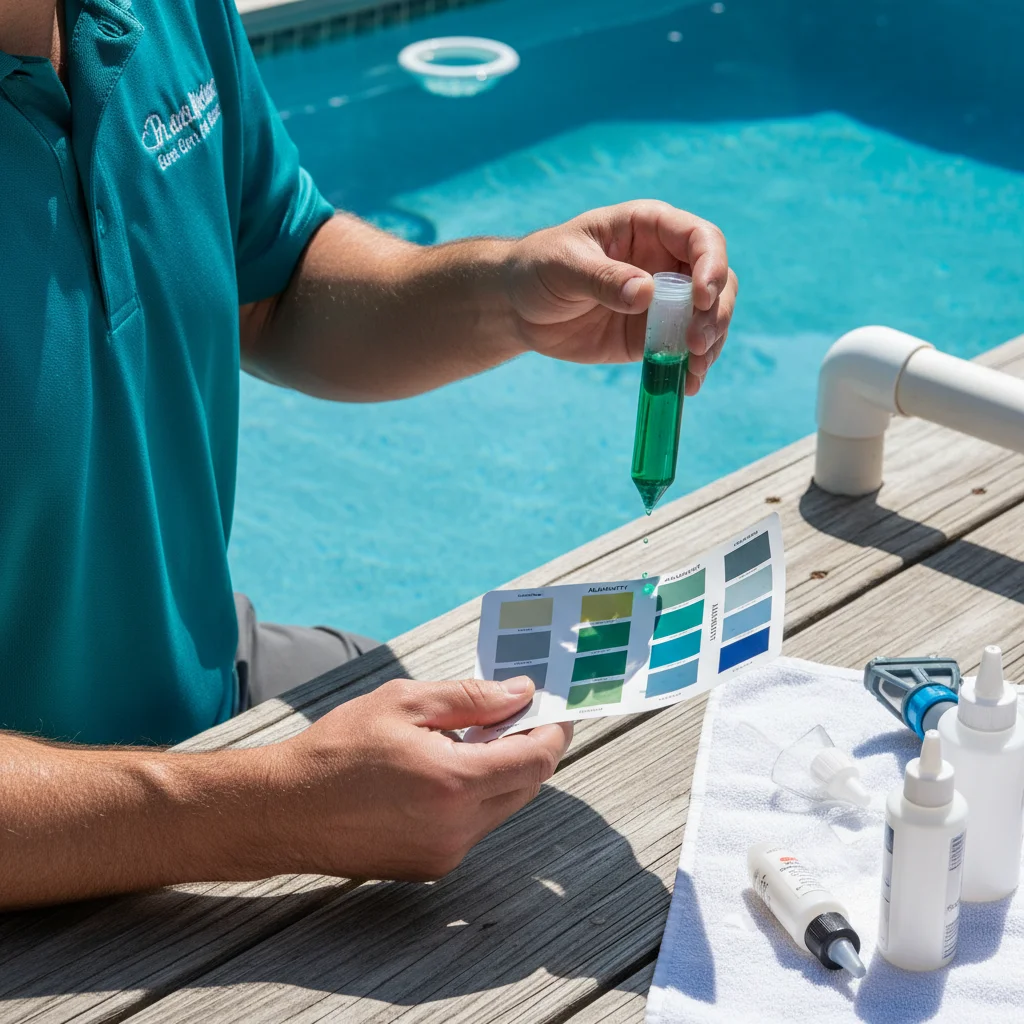
Think of total alkalinity as the buffer, or anchor, for your pool’s pH. It’s the water’s ability to resist drastic changes in pH. When your alkalinity is in the right range (80-120 ppm), your pH stays stable and your sanitizer works effectively. When it’s too high or low, you get a cascade of problems from cloudy water to equipment damage. Keeping it balanced is a cornerstone of our weekly pool cleaning service because it prevents so many other issues from starting.
What total alkalinity actually does for your pool
Total alkalinity is a measure of the dissolved alkaline substances in your water, primarily carbonates and bicarbonates. These substances neutralize acids, which is why TA acts as a buffer for your pH. It’s one of the three pillars of water balance, along with pH and cyanuric acid, that work together to keep your water safe, clear, and comfortable.
Getting this number wrong has real consequences for your pool and your swimmers.
When total alkalinity is too low (below 80 ppm):
- pH Bounce: Without its anchor, pH becomes unstable and can swing dramatically with the addition of sanitizers, bather waste, or even rainwater. This is called “pH bounce.”
- Corrosion: The water becomes acidic and corrosive. This can etch plaster surfaces, corrode metal components like ladders and heater coils, and damage your pump seals.
- Staining: Corroded metals can dissolve into the water and cause unsightly staining on your pool surfaces.
- Inefficient Chlorine: Chlorine is less stable and effective when pH is bouncing around.
- Irritation: The unstable, often acidic water can cause skin rashes and eye irritation for swimmers.
When total alkalinity is too high (above 120 ppm):
- pH Lock: The water is over-buffered, making it very difficult to lower your pH. You’ll add acid, and the pH will barely budge or will creep right back up.
- Cloudy Water: High TA often leads to cloudy or hazy water that no amount of filtering seems to fix.
- Scale Formation: This is a major issue in San Diego. The alkaline water causes calcium to come out of solution and form rough, white scale on your tile line, in your salt cell, and inside your heater. This scale can restrict water flow and cause expensive equipment failure.
- Reduced Chlorine Effectiveness: High pH, which often accompanies high TA, dramatically reduces your chlorine’s ability to sanitize, leaving you vulnerable to algae blooms.
How alkalinity and pH push each other around
It’s impossible to manage one without affecting the other. Total alkalinity and pH are chemically linked, and anything you add to the water to change one will inevitably change the other. The trick is knowing how to make adjustments in the right order and with the right technique.
Here’s the basic relationship:
- Adding an acid (like muriatic acid or dry acid) will lower both TA and pH.
- Adding a base (like soda ash) will raise both TA and pH.
- Adding an alkalinity increaser (sodium bicarbonate) will primarily raise TA and have a smaller effect on raising pH.
A common mistake pool owners make is “chasing pH.” They see high pH, so they add acid. This lowers the pH, but it also lowers the TA. If the TA was already in range or low, they’ve just created a new problem: pH bounce. Now the pH will swing wildly.
The correct approach is to always test and adjust your total alkalinity first. Get your TA locked into the 80-120 ppm range. Once it’s stable, you can make fine-tuned adjustments to your pH. Think of it like tuning a guitar: you get the string to the right general note (alkalinity) before you use the fine-tuner to get it perfect (pH). If you’re constantly struggling with this balance, our guide on how to fix pool pH goes into more detail on that specific measurement.
How to lower high alkalinity without crashing pH
This is the most common and challenging adjustment for San Diego pool owners. If your pool alkalinity is too high, you can’t just dump in a gallon of acid. Doing so will cause your pH to “crash,” plummeting into the dangerously corrosive low 6’s. The goal is to lower TA incrementally while keeping the pH in a safe range. We do this using a method that involves aeration.
The Acid and Aeration Method
- Test Your Water: Get a precise reading for both Total Alkalinity and pH using a reliable test kit.
- Calculate Your Acid Dose: Your target is to lower TA by no more than 10-20 ppm at a time. For a 15,000-gallon pool, about 24 fl oz of standard muriatic acid (31.45%) will lower TA by approximately 10 ppm. Use an online pool chemical calculator for a more precise dose for your pool’s volume.
- Add The Acid (Carefully): Turn off your pool pump. This is crucial. Pour the measured dose of acid into one spot in the deep end of the pool. Do not broadcast it across the surface. Let it sit for 30-60 minutes to allow the concentrated acid to work on the alkalinity in that area. Then, turn the pump back on to circulate the water. Always wear gloves and eye protection when handling acid.
- Circulate and Retest: Let the pump run for at least 6-8 hours. Test your water again. You’ll find that both your TA and pH have dropped.
- Aerate to Raise pH: Now, you need to raise the pH without adding chemicals that also raise TA. The best way is aeration. Turn on any water features like waterfalls, fountains, or spa spillovers. Point your return jets towards the surface to create as much agitation as possible. Aeration forces carbon dioxide out of the water, which causes the pH to rise with almost no effect on TA.
- Repeat as Needed: Continue aerating until your pH is back in the 7.4-7.6 range. Test your TA again. If it’s still too high, repeat the process, add another dose of acid, circulate, and then aerate the pH back up. This might take a few cycles over a couple of days, but it’s the only way to lower TA without sending your pH into a nosedive.
How to raise low alkalinity safely
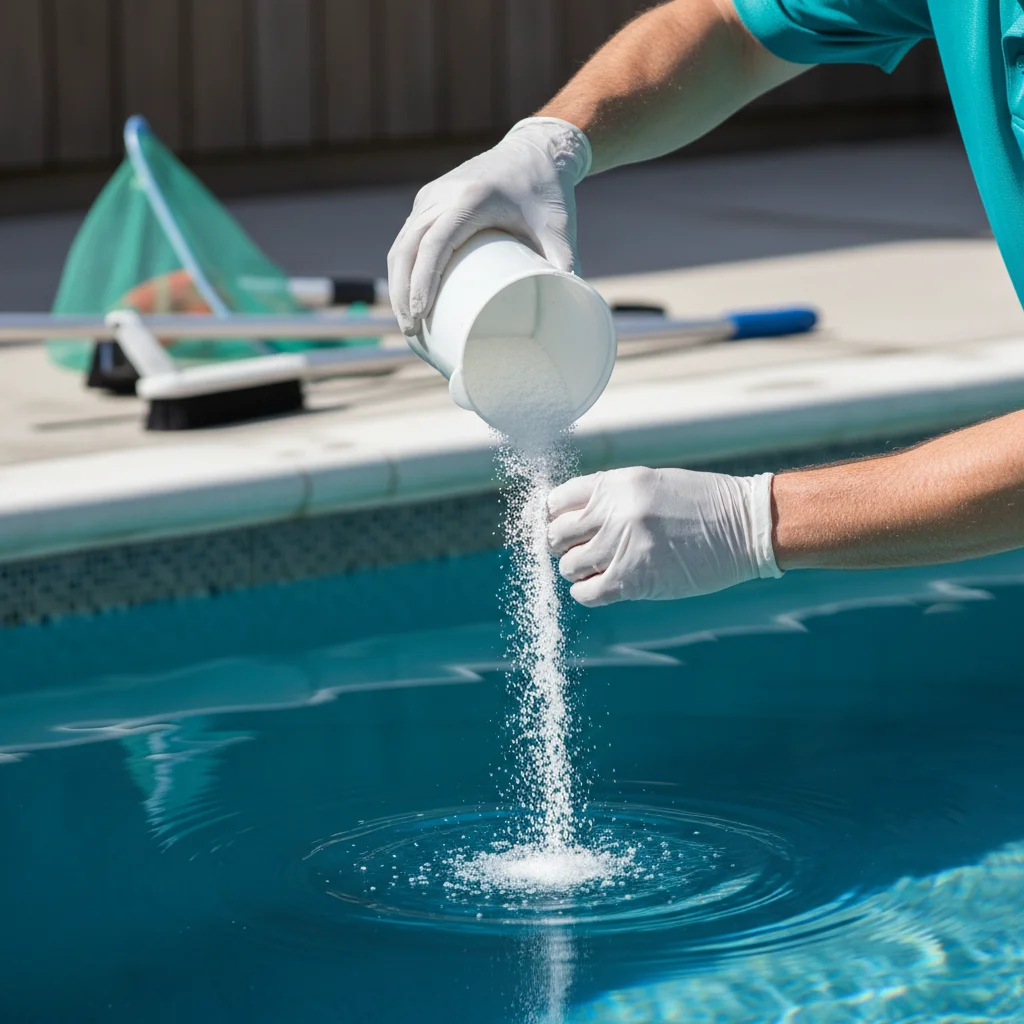
This is a much simpler process. If your test strip shows your total alkalinity is below 80 ppm and your pH is bouncing all over the place, you need to add an alkalinity increaser. The go-to chemical for this is sodium bicarbonate, which is essentially a purer, more granular form of household baking soda.
- Test and Calculate: First, confirm your low TA reading with your test kit. The goal is to raise it into the 80-120 ppm range. To raise the TA by 10 ppm in a 15,000-gallon pool, you’ll need approximately 2.1 pounds of sodium bicarbonate.
- Turn on the Pump: Make sure your pump is running and the water is circulating before adding any chemicals.
- Add the Increaser: You can add sodium bicarbonate in one of two ways. You can pre-dissolve it in a bucket of pool water and pour the solution around the perimeter of the pool. Or, you can broadcast the dry powder slowly over the surface of the water, avoiding dumping it in one clump.
- Brush and Circulate: Gently brush any powder that settles on the pool floor to help it dissolve. Let the pump run for at least 6-8 hours to fully distribute the chemical.
- Retest: After several hours, test your water again. Your TA should now be in the ideal range. Note that sodium bicarbonate will also cause a slight increase in your pH, so you may need to make a small downward adjustment to your pH afterward.
Why San Diego pools drift high (and what to do about it)
If it feels like your pool’s alkalinity is always creeping up, you’re not imagining it. Here in San Diego County, our water chemistry presents a unique challenge. Most of our tap water is imported by the San Diego County Water Authority from sources like the Colorado River. This water is naturally hard, meaning it has a high mineral content and, consequently, a high starting total alkalinity right out of the tap.
When you fill your pool with this water, you’re already starting with high TA. Then, our sunny, arid climate causes a high rate of evaporation. As pure water evaporates, all those dissolved minerals and alkaline substances are left behind, becoming more and more concentrated over time. This is why you’ll see your TA, calcium hardness, and total dissolved solids (TDS) steadily climb throughout the year.
Furthermore, the widespread use of solid chlorine tablets (trichlor) contributes to the problem. Trichlor is acidic and constantly pushes your pH down. To counteract this, pool owners add a pH increaser like soda ash. But soda ash also raises total alkalinity. This creates a frustrating cycle where you’re constantly fighting low pH and adding a chemical that makes your high TA problem even worse.
The solution is proactive management. Regular, accurate testing lets you catch the upward creep early and make small corrections before it becomes a major issue. For some pools, switching from trichlor pucks to liquid chlorine (sodium hypochlorite) can help break the cycle, as liquid chlorine has a high pH and can reduce the need for soda ash. Ultimately, the best long-term solution for high TDS and alkalinity creep is to perform a partial drain and refill every 2-3 years. This is the only way to truly reset your water chemistry by diluting the concentration of minerals.
When to call us
Chasing alkalinity and pH can feel like a full-time job. If your water is persistently cloudy, you’re seeing scale buildup, or you just can’t get your test kit readings to stabilize, it’s time to call in a professional. We have the commercial-grade testing equipment and experience to diagnose complex water balance issues quickly. Don’t let a chemistry problem lead to expensive equipment damage.
Call us at (760) 642-1256 for a same-day estimate.
Frequently asked questions
What's the ideal total alkalinity for a pool?
The ideal range is 80-120 parts per million (ppm). For pools with a salt system or plaster finish, we often aim for the lower end of that range, around 80-100 ppm, to help prevent scale buildup.
Can I swim in a pool with high alkalinity?
While not immediately dangerous, high alkalinity can cause skin and eye irritation. More importantly, it makes your chlorine less effective and can lead to cloudy water and damaging scale buildup. It's best to correct it before swimming.
How long does it take to lower pool alkalinity?
Lowering alkalinity is a gradual process. After adding acid, you must wait at least 6-8 hours with the pump running for the water to circulate fully before retesting. The entire process of lowering alkalinity while managing pH can take a day or two of careful adjustments.
Will baking soda raise my pool's pH?
Yes, baking soda (sodium bicarbonate) will raise both total alkalinity and, to a lesser extent, pH. It's the primary chemical pool professionals and homeowners use to increase alkalinity.
Need professional help in San Diego County?
Splash Pro Pools provides every service in this post. Call for a free quote.