You’re standing at the pool supply counter, or clicking through product pages, and someone’s asking whether you want sand, cartridge, or DE. The honest answer is that the right choice depends on your pool’s size, how much you use it, and some quirks that are specific to San Diego’s water supply. Here’s what actually matters.
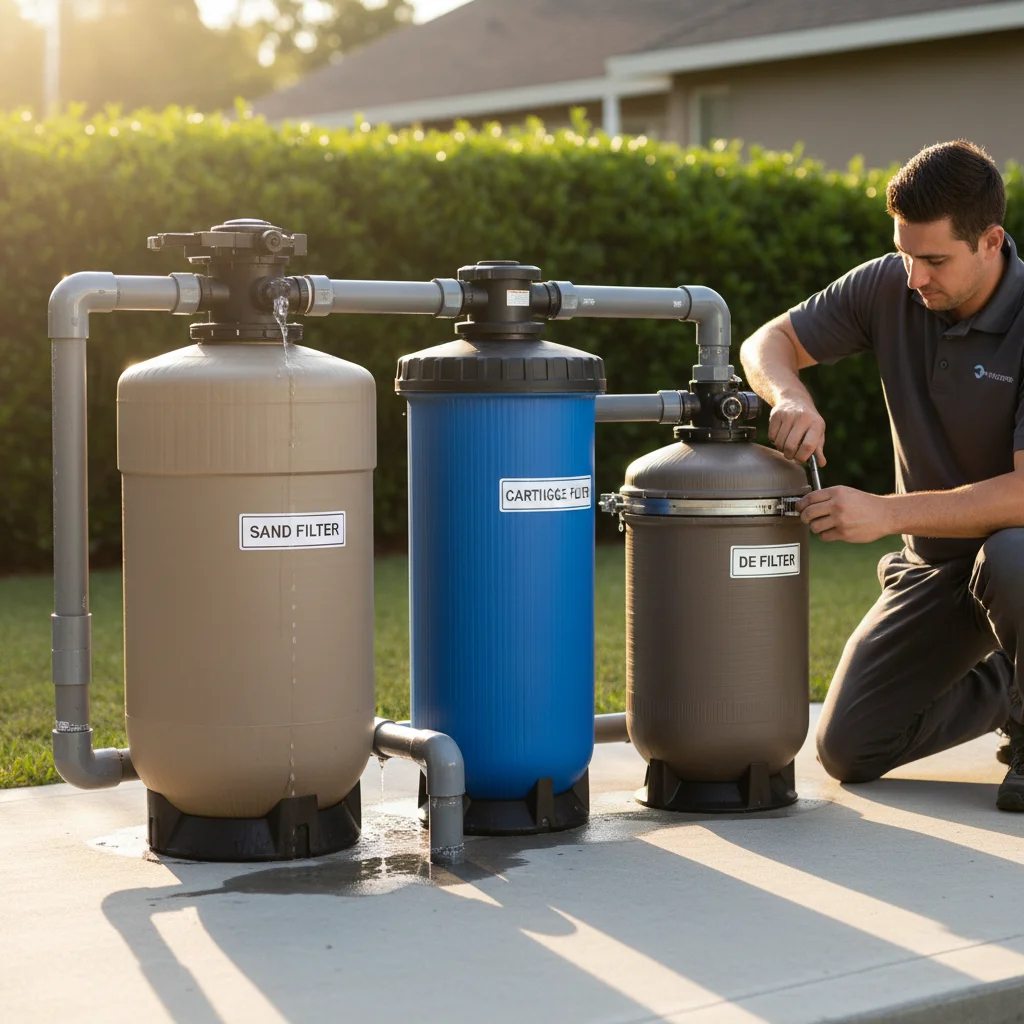
How each filter type actually works
Every pool filter does the same job: push water through a medium that traps debris, then return clean water to the pool. The difference is what that medium is and how fine it filters.
Sand filters
Water flows down through a tank packed with specially graded silica sand. Dirt and particles get trapped between the sand grains. When pressure builds, typically 8-10 psi above baseline, you backwash: reverse the flow to flush debris out through a waste line. Sand catches particles down to about 20-40 microns. That’s adequate for most residential pools, though the water clarity won’t be as sharp as the other two options.
Cartridge filters
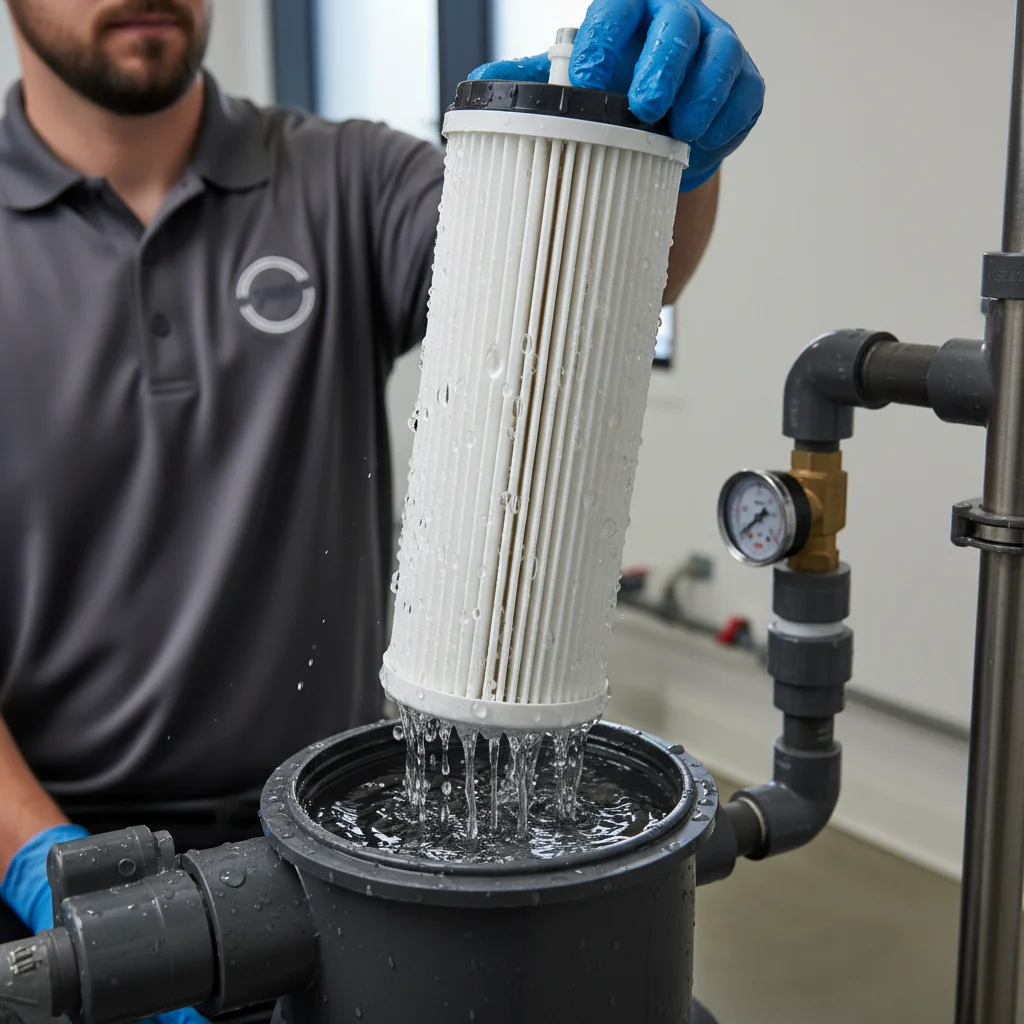
Water passes through a pleated polyester element, similar in concept to an air filter in your car. Cartridge filters don’t backwash, you open the canister, pull out the element, and rinse it with a hose. They filter down to about 10-15 microns, so the water tends to run noticeably clearer than sand. No backwash valve means simpler plumbing and no water discharged to waste during cleaning, a real advantage in a drought-conscious region.
Diatomaceous earth (DE) filters
DE filters use a powder made from fossilized algae shells to coat a set of internal grids. That powder is extraordinarily porous, filtering particles down to 2-5 microns. The result is the clearest pool water you can get with a standard filter. When pressure climbs, you backwash like a sand filter, but you also need to recharge with fresh DE powder afterward. Once a year you pull the grids and clean them manually. California’s DE disposal rules require you to bag the spent powder for landfill, not hose it into the storm drain.
Cost, maintenance time, and water use compared
The purchase price is only part of the equation. What you spend maintaining a filter over three to five years matters more than the sticker price.
Sand filters have the lowest upfront cost, a quality residential unit runs roughly $300-$600 installed. Replacement sand costs $30-$60 every five to seven years. The catch is backwashing. Each cycle uses 200-300 gallons of water. If you’re backwashing weekly, that adds up fast on a San Diego water bill.
Cartridge filters cost more upfront, typically $500-$900 installed for a residential pool, and replacement cartridges run $50-$150 each, depending on size. But they use no water during cleaning, just a garden hose. For a pool used several times a week, cartridge cleaning takes 20-30 minutes every four to six weeks. That time investment is predictable.
DE filters sit at the top of the price range, $700-$1,200 installed is common, plus the ongoing cost of DE powder (around $30-$50 per 25-pound bag). They do require backwashing, so they share the water-use downside with sand. The annual teardown and grid inspection is either a DIY afternoon or a service call. Our pool filter cleaning and replacement service covers all three types if you’d rather not deal with it yourself.
For a more detailed breakdown of what pool upkeep costs in San Diego overall, the pool maintenance cost guide breaks down the full picture.
Why San Diego’s hard water changes the math
San Diego’s tap water is among the hardest in California. The San Diego County Water Authority reports that imported water from the Colorado River and State Water Project consistently delivers water with total dissolved solids (TDS) in the 400-600 ppm range by the time it reaches your tap. That mineral content, primarily calcium and magnesium, doesn’t evaporate. It concentrates as water splashes and evaporates from your pool.
The practical effect on your filter is significant. Calcium carbonate deposits build up on cartridge pleats, stiffening them and cutting filtration efficiency. Acid washing (a diluted muriatic acid soak) restores pleats temporarily, but in San Diego conditions cartridges typically need acid washing every two to three cleanings rather than the once-a-year schedule manufacturers suggest for softer-water regions. Failing to keep up with that shortens cartridge life from the industry average of two to three years down to 12-18 months.
DE grids accumulate calcium too. If deposits aren’t dissolved off the grids during the annual teardown, DE powder can’t coat evenly, and filtration suffers. Our post on hard water and your pool covers the chemistry in detail, including how to manage calcium hardness at the pool level.
Sand filters are slightly more forgiving. The sand bed doesn’t have the surface area to calcify the way pleated media does. That said, channeling, where water finds preferential paths through the sand rather than filtering evenly, still happens more quickly in hard-water pools. Replacing sand every five years (rather than the maximum seven) is a sensible rule here.
The EPA WaterSense program offers useful context on water efficiency if you’re weighing the backwash question against local conservation goals.
Which filter we recommend by pool size and use
There’s no single right answer, but these guidelines match what we see working well across San Diego County pools.
Smaller pools (under 15,000 gallons), light to moderate use: Cartridge is usually the best fit. Smaller pools don’t generate the debris volume that makes cartridge cleaning a chore. No backwash water loss is a genuine benefit. And the improved water clarity over sand is noticeable.
Larger pools (15,000-30,000+ gallons), heavy use or lots of kids and pets: DE earns its premium here. High bather load and outdoor debris challenge any filter. DE’s 2-5 micron filtration keeps water looking clear even when the pool is getting hammered on a Saturday afternoon. If the annual teardown feels like too much, a yearly filter cleaning service makes it manageable.
Pools on larger lots with older plumbing or tight equipment pads: Sand is sometimes the pragmatic choice. It’s durable, forgiving of intermittent maintenance, and easier to service in tight spaces. If you’re already running sand and it’s working fine, there’s often no compelling reason to switch, just stay disciplined about backwash timing and sand replacement.
High-use vacation rentals or commercial settings: DE or a high-flow cartridge system, paired with a variable-speed pump. Commercial pool service has different filter sizing standards, turnover rate requirements are stricter under California Health and Safety Code.
Our complete pool filter cleaning guide walks through the hands-on steps for maintaining each type once you’ve chosen.
When to switch types vs. just replace the media
This question comes up constantly. The short answer: replace media first, switch types only when there’s a clear functional reason.
If your sand filter is five or more years old, water clarity has declined, and pressure swings aren’t correcting with backwashing, replace the sand. A fresh charge of #20 silica sand costs under $60 and often restores performance completely. Same logic applies to a cartridge that’s been acid-washed three or four times: the pleats lose their structure, and a new element fixes the problem for $50-$150.
Switch filter types when the current system is fundamentally undersized for your pool, when water quality goals have changed (say, you’ve added a spa or an infinity edge), or when ongoing maintenance costs are unsustainable. Switching is not a media swap, it means replacing the entire tank, likely updating the plumbing connections, and verifying the pump’s flow rate matches the new filter’s design specs. Undersizing a DE filter is a common mistake that results in torn grids and wasted DE powder.
If you’ve had cloudy water that doesn’t clear with chemistry adjustments, your filter system may be the culprit. The cloudy pool water guide walks through how to rule out chemistry versus filtration as the cause before spending money on new equipment.
When to call us
Filter work ranges from a 20-minute cartridge rinse you can do yourself to a DE grid teardown or a full filter replacement that involves cutting pipe. If pressure isn’t dropping after a backwash, if you’re seeing sand in the pool return jets, or if you want a professional assessment before investing in a different filter type, that’s the right time to bring in a licensed technician. Call us at (760) 642-1256 for a same-day estimate.
Frequently asked questions
How often should I clean my pool filter in San Diego?
Cartridge filters typically need cleaning every 4-6 weeks during heavy use. Sand filters need backwashing every 1-4 weeks depending on bather load. DE filters need backwashing when pressure rises 8-10 psi above baseline, usually every 4-8 weeks, plus a full teardown once a year.
Does San Diego's hard water affect which filter I should choose?
Yes. San Diego tap water averages around 300-400 ppm of total dissolved solids. That mineral load calcifies cartridge pleats faster and can cake DE grids, so both types need more frequent cleaning here than manufacturers' national averages suggest. Sand filters are somewhat more tolerant of hard water but still benefit from regular backwashing.
How long does pool filter media last?
Sand media typically lasts 5-7 years before it needs replacing. Cartridge elements last 1-3 years depending on cleaning frequency and chemical exposure. DE filter grids can last 5-10 years with proper maintenance, though the DE powder itself is recharged after every backwash.
Can I switch from a sand filter to a cartridge or DE filter?
Yes, but it's not a media swap, it requires replacing the entire filter tank and housing. The plumbing connections are often different sizes too. A licensed pool technician can assess whether your current pad layout and pump flow rate support the switch before you invest.
What is the finest filtration level each filter type provides?
Sand filters catch particles down to about 20-40 microns. Cartridge filters filter to roughly 10-15 microns. DE filters provide the finest filtration, catching particles as small as 2-5 microns, which is why they produce the clearest water of the three types.
Need professional help in San Diego County?
Splash Pro Pools provides every service in this post. Call for a free quote.