April and May are the months when San Diego pool owners flip that heater switch after weeks of mild weather, and find out it didn’t survive the off-season. If yours isn’t heating, is throwing an error code, or cuts out after five minutes, here’s what’s actually wrong and what it’s going to take to fix it.
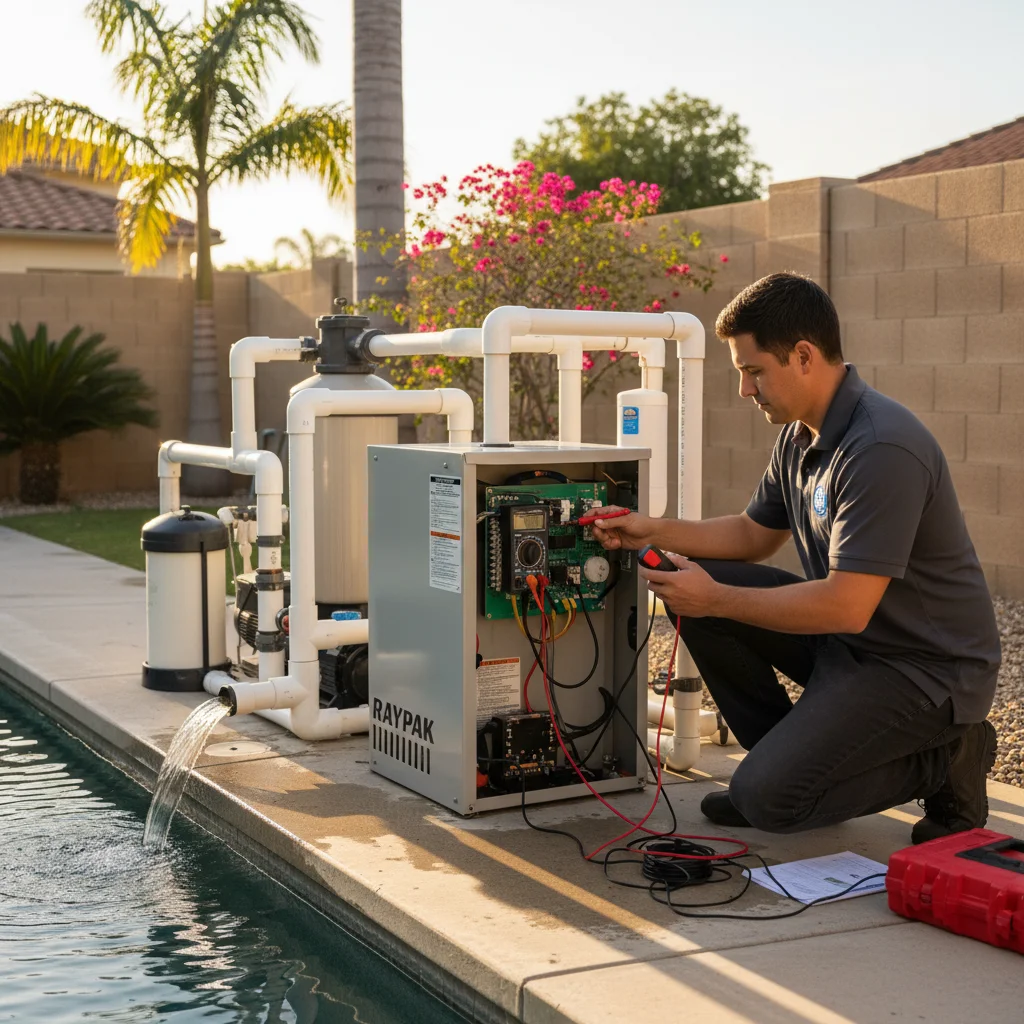
The five most common pool heater failures we see
1. Ignition failure
This is the most common call we get. The heater tries to fire, you hear a click, and nothing happens, or it lights briefly and then goes out. The usual culprits are a worn igniter, a dirty or cracked flame sensor, or low gas pressure. Igniter replacement runs $150-$250 in parts and labor. If the gas valve itself is the problem, that’s closer to $300-$450.
2. Pressure switch failure
The pressure switch tells the heater that water is actually flowing before it allows ignition. When the switch fails, or when flow is genuinely too low, the heater refuses to start. A clogged filter is often the real villain here. If you haven’t cleaned your filter recently, that’s the first thing to check. A new pressure switch is a $50-$120 part, cheap to fix once diagnosed.
3. High-limit switch trips
The high-limit switch is a safety device. It cuts the heater if the water temperature inside gets dangerously high, usually because of scale buildup in the heat exchanger restricting flow. If it trips once and resets, keep an eye on it. If it’s tripping repeatedly, there’s an underlying cause, scale, low flow, or a failing thermostat, that won’t fix itself.
4. Control board failure
Control boards are sensitive to moisture, salt air, and power surges. A failed board often shows up as a blank display, random error codes, or a heater that’s completely unresponsive. Replacement boards for Pentair, Raypak, and Hayward units run $250-$500 for the part alone. Labor brings the total to $400-$650. If the board is on a heater that’s already 10+ years old, that repair cost changes the repair-vs-replace math significantly.
5. Heat exchanger corrosion or scaling
This is the most expensive single failure. The heat exchanger is where combustion gases transfer heat to pool water. Scaling from hard San Diego water narrows the passages and forces the high-limit switch to trip. Actual corrosion, common in coastal areas, can cause pinhole leaks that put combustion gases in contact with pool water. That’s a safety issue, not just a performance issue. Heat exchanger replacement can cost $800-$1,500 or more, which is often close to the price of a new mid-range heater.
Gas vs. heat pump vs. solar, different problems, different costs
Each heater type has its own failure modes, and knowing which one you have changes what you’re diagnosing.
Gas heaters (Raypak, Hayward H-Series, Pentair MasterTemp) heat fast and are the most common type in San Diego. They have combustion components, igniters, gas valves, heat exchangers, that wear out. Repairs are generally straightforward if parts are available, but older units (pre-2010) sometimes have discontinued components that make repair impractical.
Heat pumps (Hayward HeatPro, Pentair UltraTemp) extract heat from the air rather than burning gas. They’re more efficient in San Diego’s mild climate and tend to be more reliable mechanically, but when they do fail, the culprits are often refrigerant leaks, compressor failure, or defrost board issues. Refrigerant work requires an EPA 608-certified technician. Compressor replacement on a heat pump can run $800-$1,200, which frequently tips the math toward replacement on older units. Our pool equipment installation and upgrades team handles heat pump swaps regularly.
Solar heaters have almost no mechanical parts, no igniter, no gas valve, no refrigerant. Most problems are plumbing-related: cracked panels, valve failures, or sensor issues with the controller. We covered solar heater maintenance in detail in our solar pool heater guide.
Cost comparison in rough terms: gas heater repairs average $200-$600 for most common failures. Heat pump repairs run $300-$1,200. Solar repairs are usually $100-$400 unless panels need replacement.
Error codes from Pentair, Raypak, and Hayward decoded
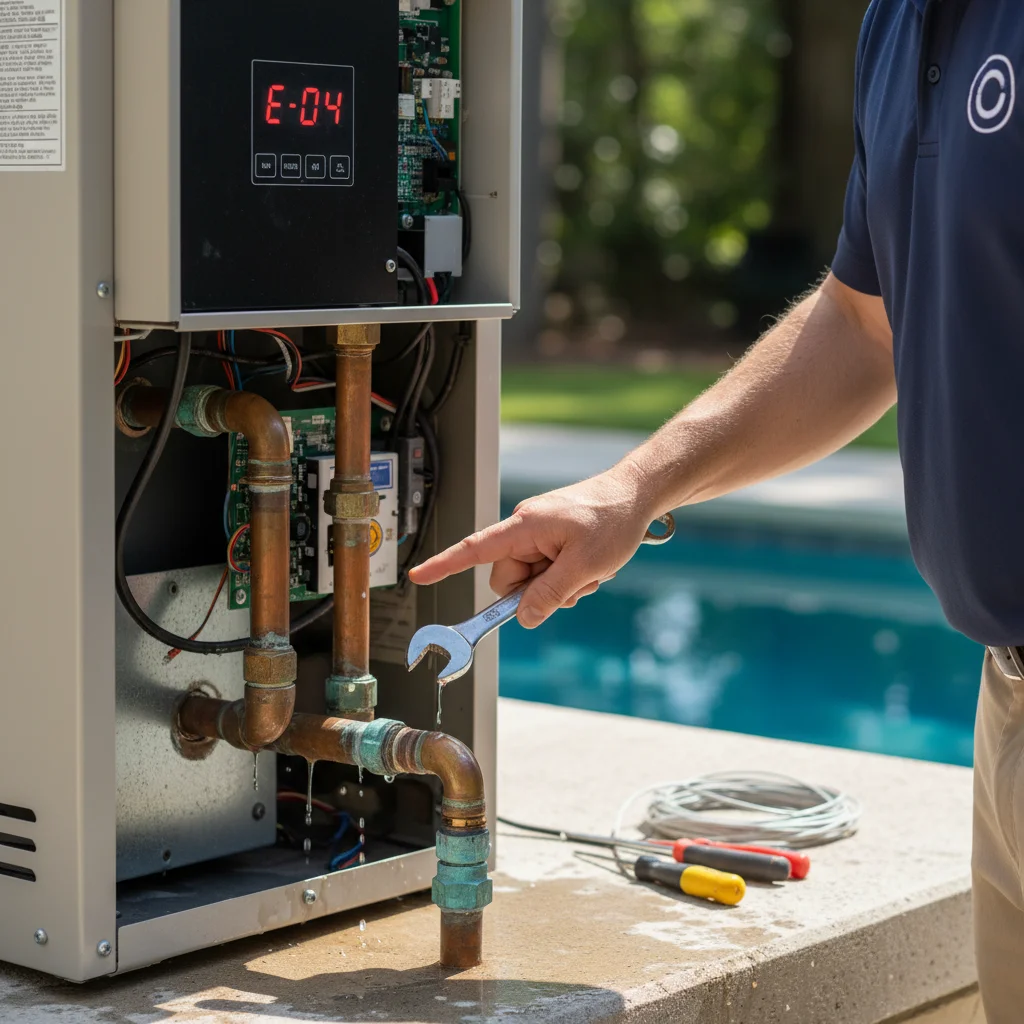
Error codes are the heater’s way of telling you what it thinks is wrong. They’re a starting point for diagnosis, not a final answer.
Pentair MasterTemp / Max-E-Therm
- E05 / Ignition failure: The heater attempted to ignite three times and failed. Check gas supply first, then the igniter and flame sensor.
- E01 / Stack flue sensor: The sensor that reads exhaust temperature has failed or is reading out of range. Often a sensor replacement, but can indicate combustion problems.
- HLS / High limit switch: Temperature exceeded safe limits. Check flow rate, filter condition, and heat exchanger scaling.
Raypak 206A–407A series
- AO (Automatic Overheat): High-limit lockout. The unit won’t restart until it cools and the fault clears. If it returns quickly, there’s a flow or scaling problem.
- LO (Low Water Temperature): Below minimum operating temperature, usually a sensor issue rather than actual water temp in San Diego.
- 3 flashes on LED: Ignition lockout. Same diagnostic path as Pentair E05, gas supply, igniter, flame sensor.
Hayward H-Series
- IF (Ignition Failure): Couldn’t establish flame. Gas valve, igniter, or flame sensor.
- HL (High Limit): Flow problem or scale buildup tripping the safety.
- BD (Bypass Detected): The bypass valve is open or the pressure switch sees insufficient flow.
One thing all three brands share: if a code clears on reset and comes right back, the fault is active and persistent. That means a part is failing, not just glitching. Repeated resets on an AO or HL code can damage the heat exchanger.
Repair vs. replace: when each makes sense
The rule of thumb most technicians use is the 50% rule: if a repair costs more than half the price of a comparable new unit, replacement deserves serious consideration. In San Diego, a new mid-range gas heater (400,000 BTU Raypak or Pentair) runs $1,800-$2,800 installed. A heat pump is $2,500-$4,500 depending on BTU rating.
Repair usually makes sense when:
- The heater is under 8 years old
- The repair is a single component under $500
- The heat exchanger is clean and structurally sound
- Parts are still available and not backordered indefinitely
Replacement usually makes sense when:
- The heater is 10+ years old and on its second or third significant repair
- The heat exchanger needs replacement (cost approaches new unit price)
- The unit uses a discontinued control board or obsolete gas valve
- You’re switching fuel types or upgrading BTU capacity
Our pool repair team always gives you the honest math before recommending one path over the other. We’ll tell you when a repair doesn’t make financial sense.
Why coastal San Diego heaters fail sooner
San Diego’s climate is famously gentle on people and rough on pool equipment. The specific combination of salt air, marine layer humidity, and hard water from the San Diego County Water Authority creates accelerated corrosion and scaling that shortens heater life noticeably compared to inland areas.
Salt air is the biggest culprit for coastal homes, roughly anything west of the I-5 corridor and within a mile of the water. Copper heat exchangers oxidize faster. Burner trays rust through. Control boards corrode even when they’re not getting wet. Heaters in La Jolla, Del Mar, Ocean Beach, and Coronado typically show corrosion damage two to four years earlier than identical units in Santee or El Cajon.
Hard water compounds the problem. San Diego water averages around 300-400 ppm total dissolved solids depending on the source blend. That calcium deposits in the heat exchanger over time, cutting flow and forcing high-limit trips. You can slow this with proper water chemistry, but you can’t stop it entirely. If your heater is coastal, budget for a slightly shorter service life and inspect the heat exchanger annually rather than every other year.
Salt chlorine generators add a third stressor. Salt pools produce trace chlorine gas and low-level acidic byproducts that accelerate metal corrosion inside the heater. Not dramatically, but measurably over time. If you’ve converted to salt, make sure your heater manufacturer’s warranty specifically covers salt pool use, not all of them do.
The California Energy Commission has published efficiency standards that newer heaters are required to meet, which is one reason modern units tend to be built with better corrosion-resistant materials than units from a decade ago.
When to call us
If your heater is throwing a code that returns on reset, short-cycling, or completely unresponsive, that’s not a DIY situation, gas appliance work and refrigerant handling require licensed contractors, and improper repairs can void manufacturer warranties. Before hiring anyone, verify their CSLB license to confirm they hold the right classification for the work. Call us at (760) 642-1256 for a same-day estimate.
Frequently asked questions
How much does pool heater repair cost in San Diego?
Most repairs fall between $150 and $650 depending on the part. Igniter replacements run $150-$250. Control board swaps land closer to $400-$650. Heat exchanger work is the expensive end, sometimes $800 or more, which is when replacement becomes worth discussing.
Why does my pool heater keep turning off after a few minutes?
Short-cycling is usually a flow issue, a dirty filter, or a faulty pressure switch. It can also be a high-limit switch tripping because the heat exchanger is scaling up. A tech can pinpoint it quickly with a flow reading and a visual inspection of the firebox.
How long do pool heaters last in San Diego?
Gas heaters typically last 8-12 years inland, but coastal units near the ocean can start showing corrosion damage in 5-7 years. Heat pumps generally last 10-15 years. Salt pools and homes within a mile of the coast shorten those lifespans noticeably.
Can I reset a pool heater error code myself?
You can clear most codes by cycling power at the breaker for 60 seconds. If the same code returns immediately, the underlying fault is still active and needs diagnosis. Don't keep resetting an AO or LO code, those are temperature lockouts that protect the heat exchanger.
Do I need a permit to replace a pool heater in San Diego?
Yes, in most cases. Gas appliance replacements typically require a permit from your local jurisdiction and must be performed by a licensed contractor. Always verify with your city's building department, and check that your contractor holds a valid C-53 or C-36 license through the CSLB.
Need professional help in San Diego County?
Splash Pro Pools provides every service in this post. Call for a free quote.