Your water bill just jumped. Your pool deck is damp in a spot it shouldn’t be. You’re refilling the pool every few days and telling yourself it’s just the heat. At some point, guessing costs more than finding out.
How much water loss is normal in Chula Vista summers
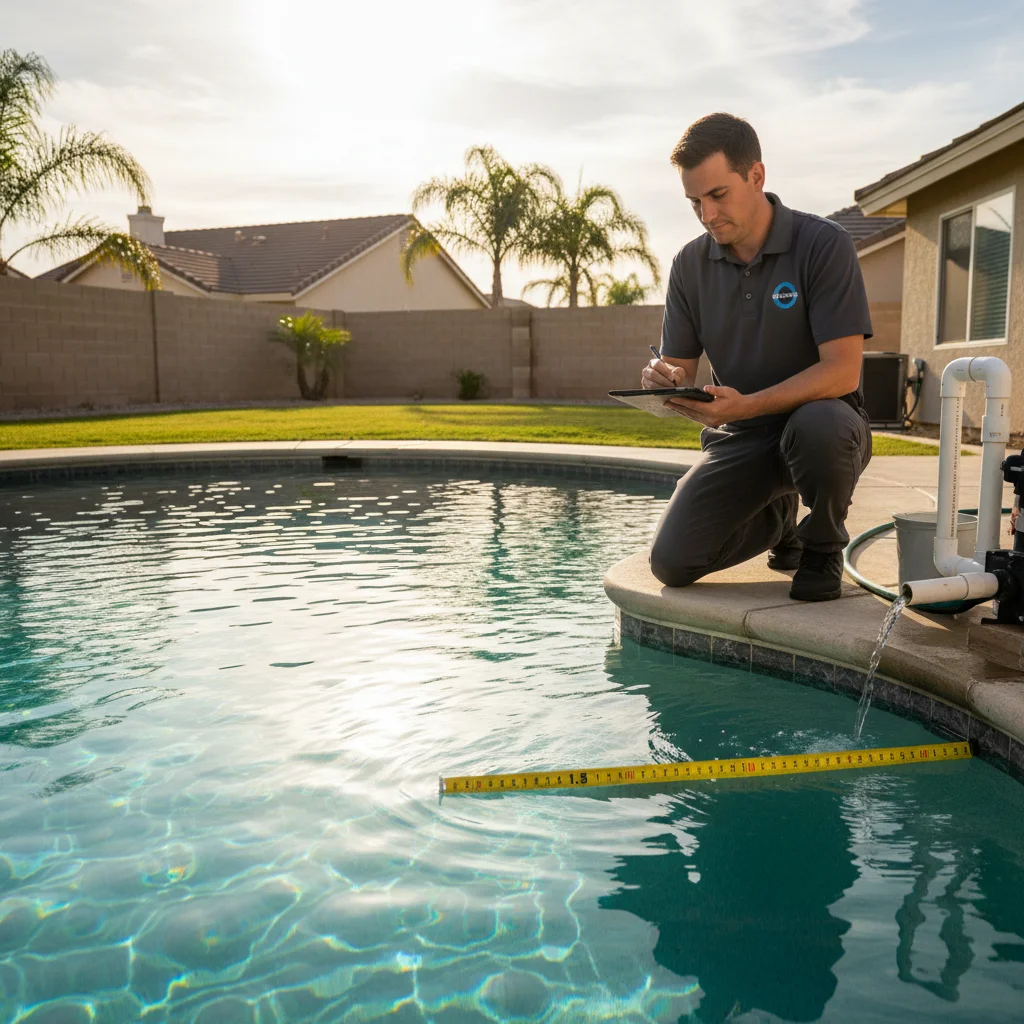
Chula Vista sits close enough to the coast that marine layer keeps mornings mild, but inland heat and afternoon winds push evaporation higher than most pool owners expect. A reasonable benchmark: 1/4 to 1/2 inch of water loss per day during July and August. That works out to roughly 1.5 to 3.5 inches per week.
If you’re losing more than that, especially during cooler stretches or at night when evaporation slows down, you’re probably dealing with a leak.
The easiest check is the bucket test. Fill a five-gallon bucket with pool water and set it on the first or second step so it’s partially submerged. Mark the water level inside the bucket and on the pool wall. Come back in 24 hours. If the pool dropped significantly more than the bucket, that’s your answer.
The San Diego County Water Authority estimates that a single leaking pool can waste 20,000 to 30,000 gallons of water per year. In a drought-prone region with tiered water rates, that’s a real cost, not just an environmental one. Getting ahead of a leak is worth it financially, not just for the pool itself.
One thing to keep in mind: even a small, slow leak gets worse over time. Water erodes soil, undercuts concrete decking, and saturates areas around equipment pads. What costs a few hundred dollars to fix today can become a multi-thousand dollar pool repair job if the surrounding structure deteriorates.
Plumbing leaks vs. shell leaks, telling them apart
Not all leaks behave the same way, and that matters because the fix is completely different depending on where the water is escaping.
Plumbing leaks
These originate in the pipes that carry water to and from your pool, return lines, suction lines, and the plumbing around equipment like your pump and filter. A few signs point here:
- The pool loses water whether the pump is running or not
- You notice wet spots in the grass or soil away from the pool
- The ground near your equipment pad stays damp
- You’re losing water fast (more than an inch a day)
Plumbing leaks are sometimes caused by shifting soil, root intrusion, or fittings that have simply aged out. Older PVC lines, especially those installed in the 1980s and 1990s, get brittle over time.
Shell leaks
These are cracks, gaps, or porous areas in the pool’s walls or floor. Signs that point to the shell:
- Water loss stops or slows at a specific level (which tells you exactly where the crack is)
- You can see visible cracks in the plaster
- Loss is consistent and gradual, not tied to pump cycles
- There’s a soft or sunken area on the pool deck near the water
Shell leaks can also show up around fittings, skimmer throats, return jets, light niches, and main drains are all common failure points. These are technically shell-adjacent leaks, and dye testing (squirting a small amount of colored dye near the fitting to watch if it gets drawn in) is often the fastest way to confirm them.
Our pool leak detection and repair service handles both categories. Knowing which type you’re dealing with before we arrive helps us bring the right equipment.
Our acoustic and pressure-test workflow
When we show up to a Chula Vista property, we’re not walking around with a hunch. There’s a structured process, and it starts with information.
We ask: when did you first notice the loss, how fast is it dropping, and has anything changed recently, new equipment, recent digging, heavy rain? That context shapes what we test first.
Pressure testing the plumbing
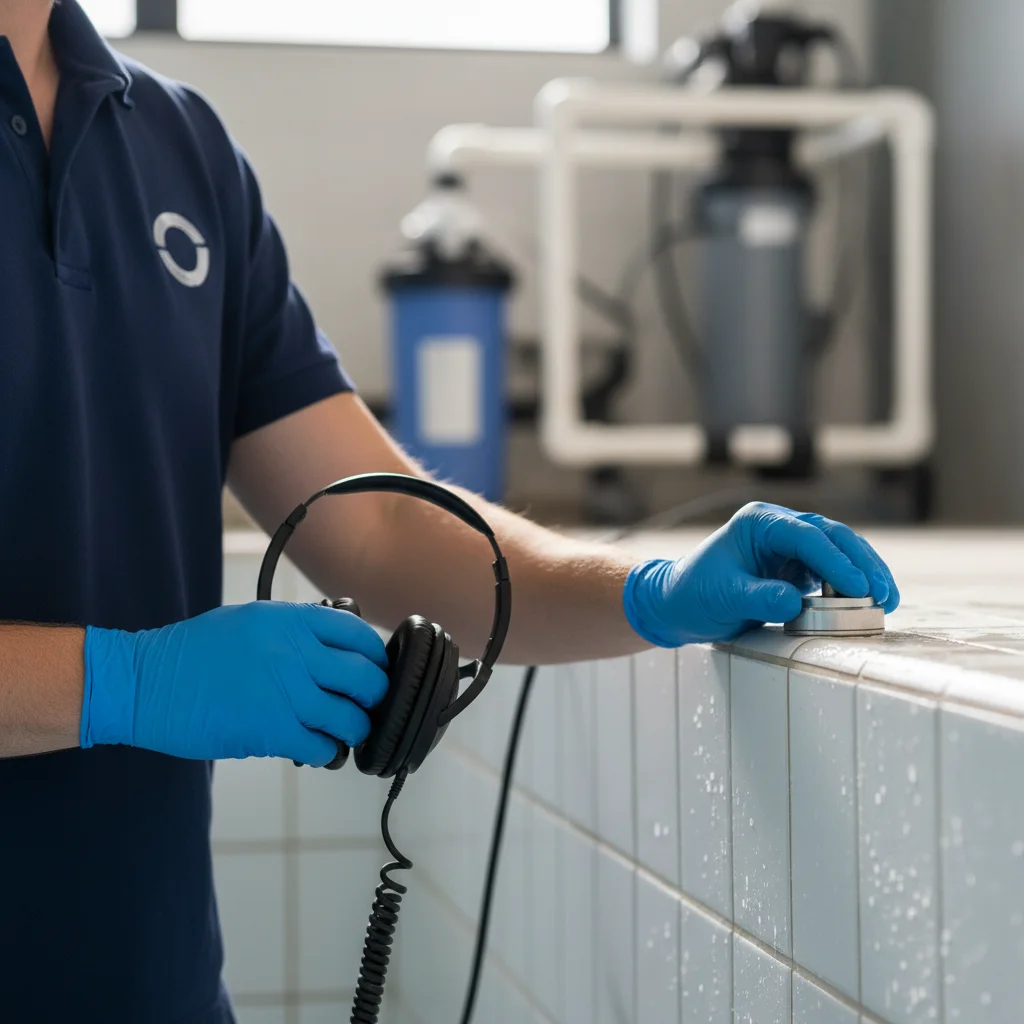
We isolate each line, returns, skimmer, main drain, and plug the fittings at the pool. Then we pressurize each line with air or water and monitor the gauge. A line that won’t hold pressure has a leak somewhere along its length. This tells us which line is compromised before we dig anything up.
Acoustic detection
For leaks in the shell or at fittings, we use an electronic acoustic listening device. The probe is placed against the pool wall, deck, or equipment housing, and the amplifier picks up the sound of escaping water, a distinctive frequency that stands out from ambient noise. It’s genuinely impressive how precisely a skilled tech can pinpoint a leak this way, often within a few inches.
Dye testing
For suspected fitting leaks, we use a thin stream of colored dye near the fitting in question. If there’s a leak, the dye gets drawn straight toward it. This is low-tech but highly reliable for skimmer leaks, which are among the most common we find in Chula Vista.
We document everything and walk you through the findings before any repair work starts. No surprise line items.
Why expansive soil makes Chula Vista pools crack
This is the part most pool companies don’t mention, but it matters a lot in South Bay.
Chula Vista has significant areas of expansive clay soil, the same type that causes foundations to shift and sidewalks to heave. When clay dries out, it shrinks. When it gets wet, it swells. That cycle puts constant stress on anything buried in or surrounded by it, including your pool shell and underground plumbing.
During dry summers, the soil pulls away from the shell. During the first rains of the season, it swells back. Over years, that movement creates hairline cracks in plaster and, in more serious cases, structural cracks in the gunite or shotcrete shell underneath.
New construction pools in Chula Vista are supposed to account for soil conditions in the engineering and design. But older pools, especially those built before geo-technical reports were standard, may not have adequate steel reinforcement or deck isolation joints. If you have an older pool and you’re seeing cracks, the soil is a likely contributor.
This is also why we always look at the deck around a leaking pool. A sinking or tilting deck section is a visible sign of soil movement below, and it often correlates with underground plumbing damage that isn’t visible from the surface.
If a crack is structural, all the way through the shell, a plaster patch won’t hold long-term. That typically calls for hydraulic cement or epoxy injection, followed by replastering the affected area. You can read more about what that kind of work involves in our guide to pool repair.
Typical repair costs and what’s covered by warranty
Leak detection itself is a separate line item from repair. In San Diego County, professional detection, including pressure testing, acoustic scanning, and a written report, typically runs between $150 and $350 for a residential pool. That fee is often credited toward repair work if you move forward with the same company.
Repair costs vary widely based on what we find:
- Skimmer throat replacement: $200-$500 depending on access and materials
- Plumbing line repair (exposed or accessible): $300-$700
- Plumbing line repair (buried, requiring excavation): $800-$2,500+
- Crack repair (plaster-level): $150-$400 per crack depending on size
- Structural crack repair: $500-$2,000+, plus replastering costs
Any contractor doing leak repair in California should be licensed. You can verify a pool contractor’s CSLB license at the California State License Board’s license check tool before work begins.
On warranties: reputable contractors typically warrant plumbing repairs for one to three years on parts and labor. Structural crack repairs carry shorter warranties because ongoing soil movement is outside anyone’s control. Get the warranty terms in writing before signing anything.
Homeowners insurance sometimes covers sudden structural damage, but rarely covers detection or gradual leak repair. Check with your insurer, it’s worth the call before you assume you’re paying everything out of pocket.
If you’ve noticed your pool losing water faster than evaporation explains, and you want to check on related posts, our pool leak detection guide for Encinitas covers similar diagnostics for North County properties with different soil conditions.
When to call us
If the bucket test confirms a leak, or you’re refilling your Chula Vista pool more than once a week without an obvious cause, it’s time to bring in a licensed pro. Acoustic and pressure testing requires specialized equipment and hands-on experience, guessing at the source often leads to digging in the wrong place and spending more money than necessary. Call us at (760) 642-1256 for a same-day estimate.
Frequently asked questions
How do I know if my pool is leaking or just evaporating?
Use the bucket test: fill a bucket with pool water, set it on a step, and mark both water levels. After 24 hours, if the pool dropped more than the bucket, you have a leak. In Chula Vista summers, evaporation alone typically accounts for 1/4 to 1/2 inch per day, anything beyond that warrants a professional test.
How long does a pool leak detection appointment take?
Most residential inspections in Chula Vista take 2 to 4 hours. Pressure testing the plumbing lines and doing a full acoustic scan of the shell can be done in a single visit. If dye testing is needed at specific fittings, add another 30 to 60 minutes.
Can Chula Vista soil really cause pool cracks?
Yes. Much of Chula Vista sits on expansive clay-rich soil. When that soil dries out, it shrinks and pulls away from the shell. When it gets wet, it swells and pushes back. Over years, that movement causes hairline cracks in plaster and, in worse cases, structural cracks in the shell itself.
Is pool leak detection covered by homeowners insurance?
It depends on your policy. Most standard policies cover sudden, accidental damage, not gradual leaks. Detection itself is rarely reimbursed, but if a covered event (like ground movement) caused the crack, some repair costs may qualify. Ask your insurer before assuming coverage.
What's the difference between a plumbing leak and a shell leak?
A plumbing leak is in the pipes buried under or around your pool, usually identifiable by the pool losing water regardless of whether equipment is running or off. A shell leak is a crack or gap in the pool's walls or floor, and it typically shows a consistent slow drip that doesn't change with equipment cycles.
Need professional help in San Diego County?
Splash Pro Pools provides every service in this post. Call for a free quote.