Your pool’s finish is showing its age, and you’re starting to price out the job. The quotes you’re getting vary by thousands of dollars, and nobody’s explaining why. Here’s a straight look at what Carlsbad pool resurfacing actually costs in 2026, why coastal conditions change the math, and how to hire a contractor who won’t cut corners.
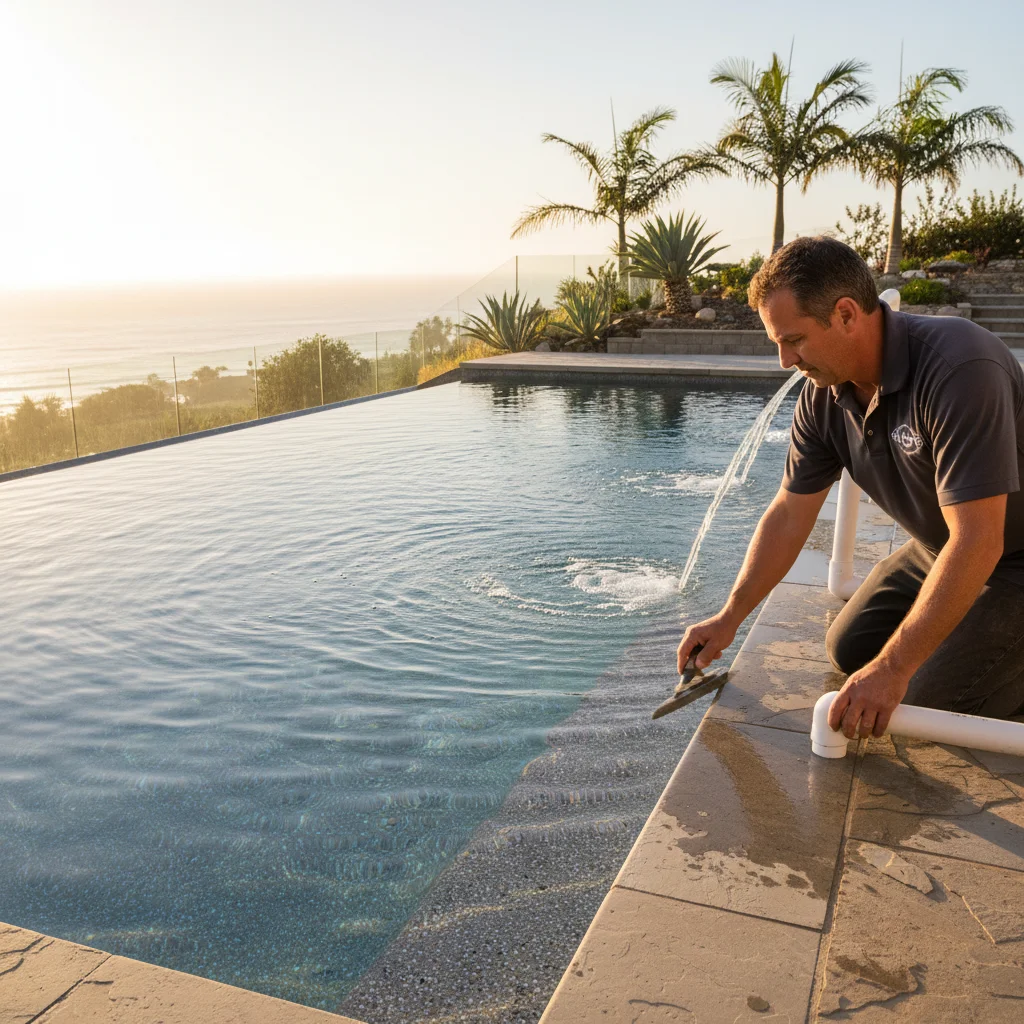
Carlsbad pool resurfacing price ranges by finish
Prices vary by finish type, pool size, and surface condition. Here’s what you’ll realistically pay in 2026 for a standard residential pool in Carlsbad (roughly 400-600 square feet of surface area):
White plaster (marcite)
The baseline option. Expect $4,500-$9,000 installed. White plaster is the most affordable finish, but it’s also the most porous and the most sensitive to water chemistry swings. It typically lasts 7-12 years in ideal conditions, and coastal Carlsbad is not ideal conditions (more on that below).
Quartz aggregate
Quartz-blended finishes, brands like StoneScapes and Beadcrete fall here, run $7,000-$12,000. They’re harder, hold color longer, and resist chemical erosion better than plain plaster. For most Carlsbad homeowners, quartz hits the best balance of cost and durability.
Pebble finishes
Premium pebble products like PebbleTec, Pebble Sheen, and comparable brands run $10,000-$18,000 for a standard residential pool. They’re the most durable option available, 20+ years isn’t unusual, and they handle salt air and aggressive water chemistry better than any other surface. The upfront cost is real, but the per-year math often favors pebble when you factor in fewer replastering cycles.
What moves the price up: larger pools, pools that need substantial prep work (grinding down old plaster, patching structural cracks, removing calcium scale from tile), and jobs that require deck or coping repairs at the same time.
For a broader look at how these costs compare across San Diego County, see our pool resurfacing cost guide and the detailed pool replastering cost breakdown for San Diego in 2026.
Plaster, pebble, and quartz: which holds up to coastal water
This is the question that matters most for Carlsbad specifically, and most contractors won’t bring it up unless you ask.
Carlsbad sits on the Pacific coast. Even if your pool is a mile inland, you’re dealing with marine-layer humidity, salt-laden air, and temperature swings that don’t affect pools in Escondido or El Cajon the same way. That environment is hard on pool surfaces, especially white plaster.
Salt air accelerates the oxidation of calcium compounds in plaster. The result: pitting, crazing, and discoloration that show up years earlier than they would for an inland pool. Carlsbad homeowners who choose standard white plaster often find themselves back in the replastering conversation in 7-9 years rather than the 10-12 years the product is rated for.
Quartz aggregate performs meaningfully better. The quartz particles reduce porosity, which limits how much salt and moisture the surface absorbs. Color stability is also better, marine UV exposure will fade white plaster to a dingy gray, while quartz blends hold their tone longer.
Pebble finishes are the most resistant of the three. The natural stone surface doesn’t react to salt air the way cement-based finishes do. If you’re within a few blocks of the coast or have a saltwater pool, pebble is worth the premium.
One more factor: if your pool already runs a salt water system, the chemistry inside the pool is also harder on plaster. Salt cells produce slightly acidic water when not balanced carefully, and that speeds up surface degradation from the inside while coastal air works from the outside. Quartz or pebble is almost always the right call for Carlsbad saltwater pools.
Signs your Carlsbad pool needs resurfacing now
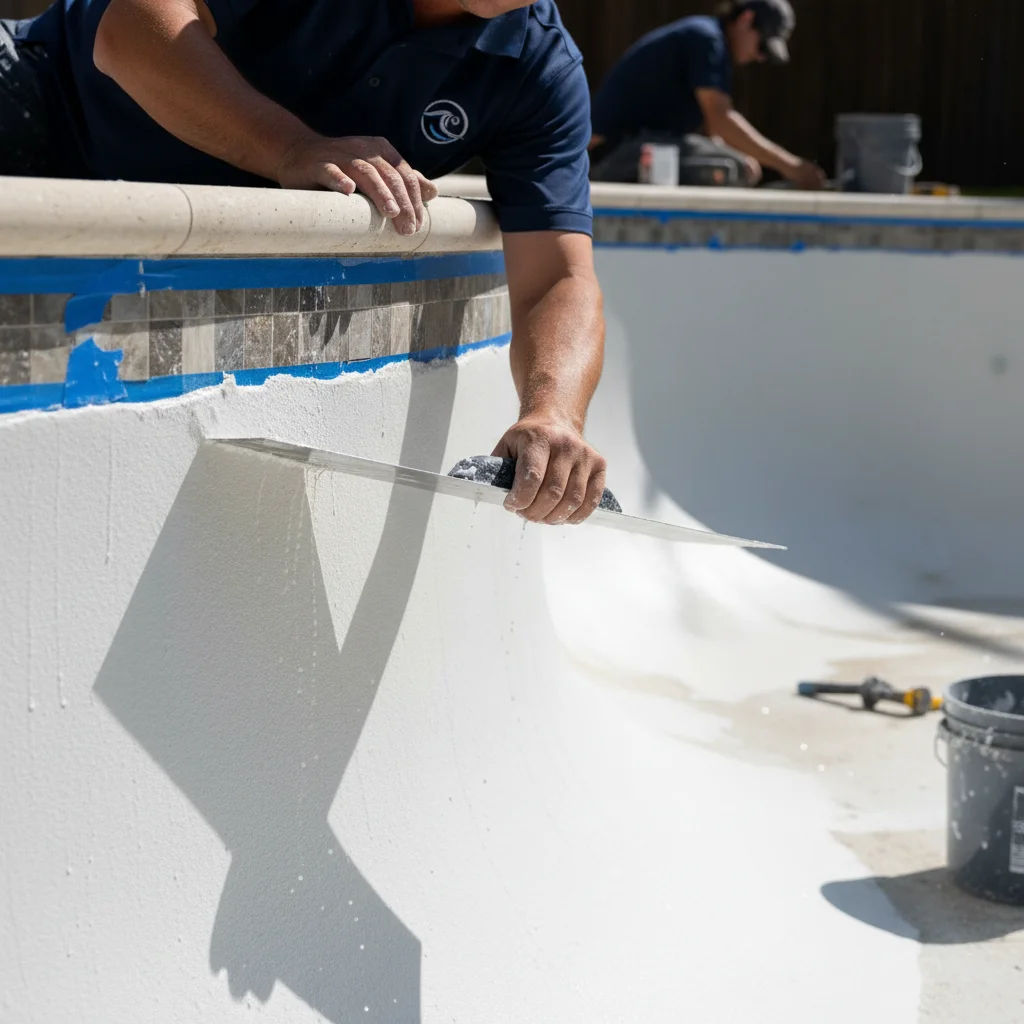
Some signs are obvious. Others creep up on you. Here’s what to look for:
Rough surface. Run your hand along the steps and shallow end. If it scratches, it’ll scratch swimmers. That’s not a chemistry problem, it’s a surface problem.
Crazing. A spiderweb pattern of fine cracks across the plaster is called crazing. It happens when the surface dries and contracts unevenly over time. Crazing can’t be patched economically; it needs full resurfacing.
Peeling or delamination. Plaster that’s separating from the shell underneath is past the point of repair. You’ll see flaking chunks or hollow-sounding spots when you tap the surface.
Staining that won’t clear. Some mineral staining responds to an acid wash or sequestrant treatment. But if you’ve tried that and the stains are still there, or if they come back within weeks, the plaster has absorbed the minerals at depth. Resurfacing is the only real fix.
Persistent water loss. Surface crazing can allow slow seepage even without a structural crack. If your pool is losing more than a quarter-inch per day in non-summer months, it’s worth having a pool leak detection check done before you resurface, you want to know if there’s a structural issue underneath.
Age. If your plaster is 12+ years old and you haven’t had it acid-washed in the last few years, it’s likely near end of life even if it looks okay. Getting ahead of complete failure saves money because a pool in poor shape requires more prep work.
Timeline and what to expect during the job
Knowing the sequence helps you plan, especially if you have a vacation or event coming up.
Day 1, drain and prep. The pool is drained completely. The existing surface is inspected, and any structural cracks are repaired with hydraulic cement. Old plaster is chipped or ground down to expose a clean bonding surface. This step matters a lot, poor prep is the most common reason new plaster fails early.
Day 1-2, application. The new finish is applied in layers. For plaster, that’s typically a scratch coat followed by the finish coat. Pebble finishes involve pressing the aggregate into a fresh mortar layer, then exposing the stone through a careful acid wash after curing. A skilled crew can surface most residential pools in one day; larger or more complex pools may take two.
Day 2-3, tile and coping work. If tile cleaning, calcium removal, or coping repairs were included in the scope, those happen around the same time. Our pool tile and calcium cleaning service is often scheduled alongside resurfacing because the pool is already drained.
Days 3-14, fill and startup chemistry. This is the part homeowners underestimate. Fresh plaster is chemically reactive, and the startup process, often called a “plaster startup” or “pre-fill” startup, requires carefully staged chemistry over 7-10 days. Done wrong, it permanently discolors the new surface or causes premature scaling. A reputable contractor manages this for you and hands off a balanced pool at the end.
Plan for roughly two weeks out of the pool from drain to swim.
How to pick a resurfacing contractor without getting burned
The Carlsbad market has good contractors and it has crews who will give you a low number, disappear after the plaster is down, and leave you managing a botched startup on your own. Here’s how to sort them out.
Verify the CSLB license. California requires a C-53 (Swimming Pool) contractor’s license for pool resurfacing. Check it yourself at the CSLB license lookup tool before you sign anything. A current, clear license with no disciplinary actions is the baseline.
Ask who does the work. Some Carlsbad contractors are brokers, they take your deposit and subcontract the job to whoever’s available. That’s not automatically bad, but you need to know whose crew is in your backyard and whether they’re covered under the contractor’s insurance.
Get the startup protocol in writing. Ask specifically: “What’s your plaster startup process, and who manages it?” If they hand you a sheet and say “add this chemical on day three,” that’s a red flag. The startup chemistry is a daily job for the first week. It should be included in the contract.
Check references from coastal jobs. A contractor with inland experience isn’t the same as one who works Carlsbad, Encinitas, and Oceanside regularly. Salt air and coastal water chemistry create conditions that trip up contractors who’ve only worked in Rancho Bernardo.
Compare scope, not just price. When you get three quotes, make sure they’re for the same finish, same prep depth, and same startup service. A $2,000 gap between quotes often disappears when you realize the cheaper bid doesn’t include prep grinding or post-fill startup management. Our pool resurfacing service page outlines exactly what our Carlsbad jobs include so you can compare apples to apples.
When to call us
Carlsbad pool resurfacing is not a project to hand off to whoever picks up the phone and quotes the lowest number. The coastal environment shortens material life, and the startup chemistry after application is where most jobs go wrong. If your pool is showing any of the signs above, rough surfaces, crazing, persistent staining, or it’s simply been more than a decade since the last resurface, it’s time to get a real estimate from a crew that knows coastal San Diego pools.
Call us at (760) 642-1256 for a same-day estimate.
Frequently asked questions
How much does pool resurfacing cost in Carlsbad, CA?
Most Carlsbad pools run $4,500-$9,000 for standard white plaster, $7,000-$12,000 for quartz aggregate, and $10,000-$18,000 for premium pebble finishes. Pool size, surface condition, and coastal prep work all affect the final number.
How long does a pool resurfacing job take in Carlsbad?
The physical application usually takes one to three days. After that, you'll need seven to ten days of fill and startup chemistry before swimming. Plan on roughly two weeks from drain to dive.
Does Carlsbad's coastal air really damage pool plaster faster?
Yes. Salt-laden air oxidizes standard white plaster more aggressively than inland conditions. Most Carlsbad pools on or near the coast see plaster life reduced by two to four years compared to the San Diego inland average.
Do I need a permit to resurface my pool in Carlsbad?
Cosmetic resurfacing, replacing the finish layer only, typically does not require a City of Carlsbad building permit. If structural repairs or equipment upgrades are included, a permit may be required. Your contractor should confirm this before work starts.
How do I know if my Carlsbad pool needs resurfacing or just a patch?
Isolated chips or a single rough spot can often be patched. If you're seeing widespread crazing (a spiderweb of fine cracks), peeling, persistent staining that doesn't respond to acid washing, or rough surfaces that scratch swimmers, full resurfacing is the right call.
Need professional help in San Diego County?
Splash Pro Pools provides every service in this post. Call for a free quote.