Many San Diego homeowners love salt water pools for their softer feel and reduced need for harsh chemical handling. However, the idea that they’re completely maintenance-free is a common misconception. While a salt system automatically generates chlorine, the unique conditions of our San Diego climate and water quality demand consistent attention to keep your pool sparkling and healthy.
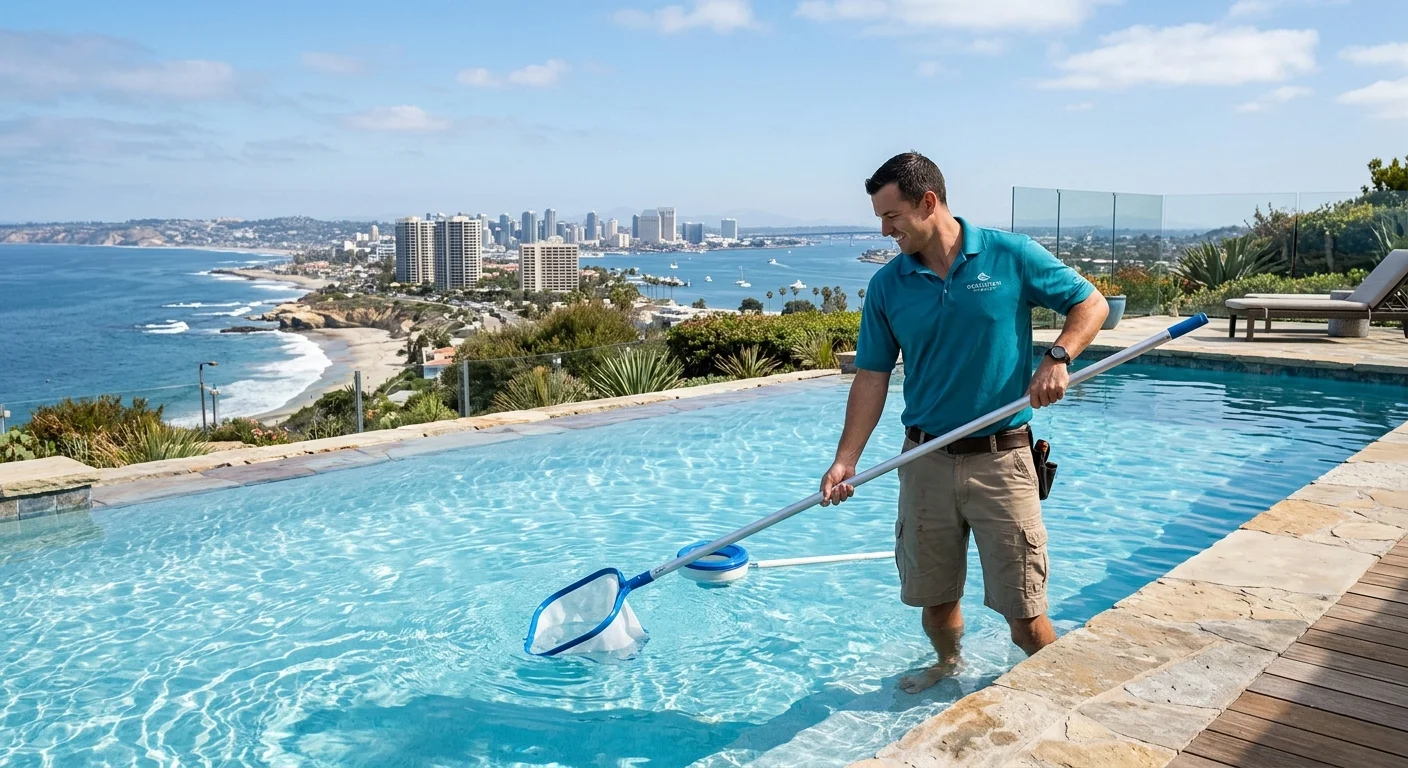
This guide offers a weekly checklist tailored for salt water pool maintenance in San Diego, ensuring your system runs efficiently and your pool stays pristine. Understanding these steps is key to enjoying all the benefits your salt water pool has to offer without unexpected issues.
Are salt water pools really ‘maintenance-free’?
The allure of a salt water pool often comes with the promise of “no more chlorine.” While technically true that you’re not adding granular or liquid chlorine directly, it’s more accurate to say that a salt water pool generates its own chlorine from dissolved salt. This means you avoid the routine handling and strong odors of traditional chlorine, but it doesn’t eliminate the need for regular pool care.
In fact, salt water pools require specific types of maintenance that are crucial for their longevity and your enjoyment. San Diego’s intense sun, high evaporation rates, and particularly hard water present unique challenges. Constant sunlight can break down chlorine faster, requiring your salt cell to work harder. High evaporation concentrates dissolved solids, including salt and calcium, which can lead to problems if not managed. This environment means a proactive approach to salt water pool care in San Diego is non-negotiable.
Neglecting regular testing, cleaning, and cell inspection can lead to chemical imbalances, algae growth, and costly equipment damage. For instance, calcium buildup, a significant concern with San Diego’s hard water, can quickly foul your salt cell and heater, reducing efficiency and lifespan. Understanding these nuances is the first step in protecting your investment and ensuring your backyard oasis remains enjoyable. If you’re considering a switch, learning more about salt water pool conversion in San Diego is a great next step, but be prepared for the ongoing care.
Your weekly salt pool checklist for San Diego’s climate
Maintaining a salt water pool in San Diego isn’t overly complicated, but it does require consistency. Our warm, sunny climate and naturally hard water mean some checks are even more critical here than in other regions. Follow this weekly checklist to keep your pool in top condition:
Skim and brush
Remove leaves, debris, and any surface film. Brush down the walls, steps, and floor of your pool. This prevents organic matter from decomposing and consuming your chlorine, and helps dislodge algae before it can take hold. In San Diego’s breezy conditions, debris can accumulate quickly.
Empty skimmer and pump baskets
Clogged baskets reduce water flow to your pump and filter, making your system work harder. Check them several times a week, especially during windy periods or after heavy use.
Test your water chemistry
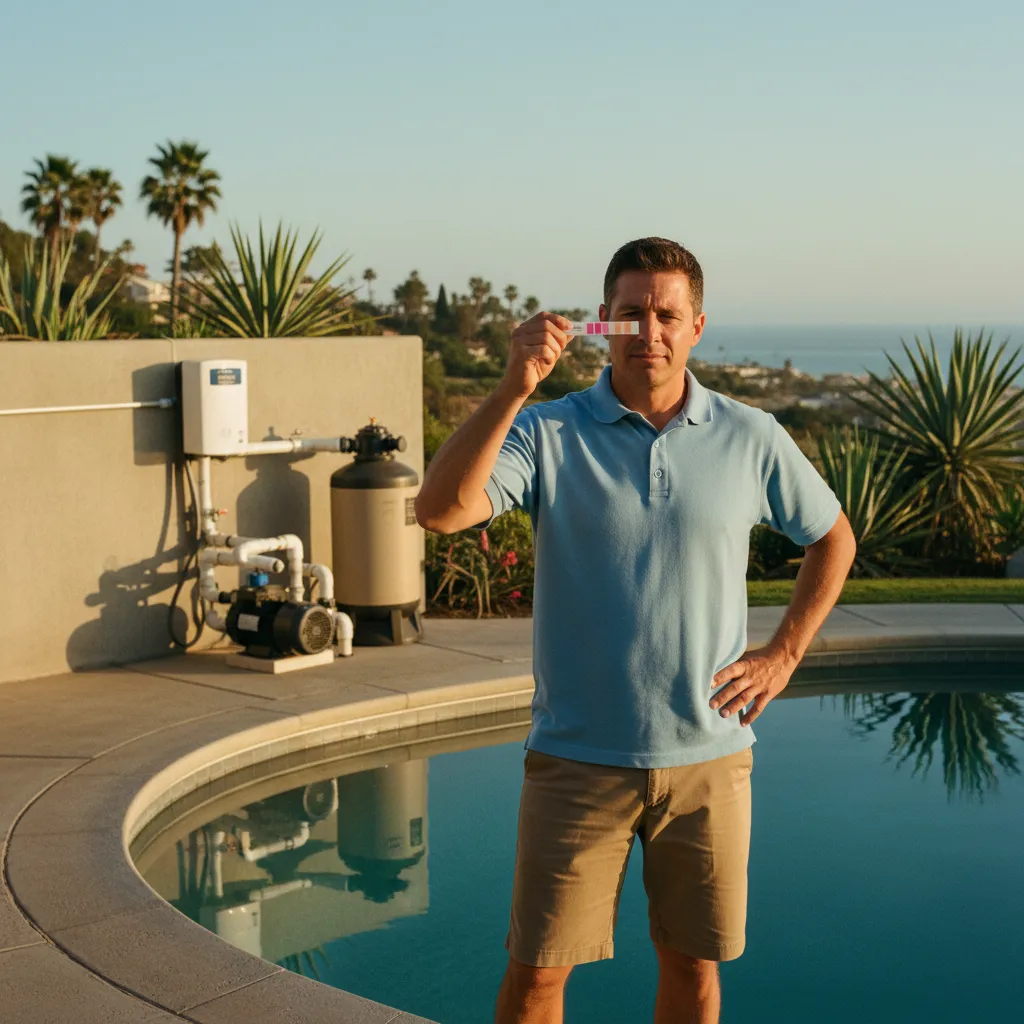
This is the most critical step. Use a reliable test kit or strips to measure:
- pH: Keep it between 7.4 and 7.8. San Diego’s hard water often pushes pH upwards, so you may need to add a pH decreaser (muriatic acid) regularly.
- Total alkalinity (TA): Maintain 80-120 ppm. This acts as a buffer for pH.
- Calcium hardness: Aim for 200-400 ppm. This is especially important in San Diego. High levels can cause scaling, while low levels can damage pool surfaces. More on this later.
- Cyanuric acid (CYA) or stabilizer: This protects chlorine from burning off too quickly in the intense San Diego sun. Maintain 30-50 ppm. Test monthly, or more often if you add fresh water.
- Salt level: Ensure your salt level is within the manufacturer’s recommended range (typically 3,000-4,000 ppm). You can use test strips, or your salt chlorinator system might have a digital readout. If low, add pool-specific salt.
- Free chlorine: Your salt cell generates this. Check that levels are between 1-3 ppm. If it’s consistently low, you might need to increase your cell’s output or consider a shock treatment.
Backwash or clean your filter
Depending on your filter type (sand, cartridge, DE), you’ll need to backwash or clean it when the pressure gauge rises 8-10 psi above its clean reading. Efficient filtration is key to clear, healthy water.
Inspect your salt cell
While we’ll dive deeper into this next, a quick visual inspection weekly can help you spot early signs of buildup.
Consistency is key for how to maintain a salt water pool in California. Sticking to this weekly routine will help prevent most common issues, saving you time and money in the long run. If these tasks feel overwhelming, remember that weekly pool cleaning services are available to handle it for you.
Testing your salt cell: how and when
Your salt cell is the heart of your salt water pool system. It’s responsible for converting salt into chlorine, so its proper functioning is paramount. Regular inspection and cleaning are essential, especially in San Diego where our mineral-rich water can accelerate calcium buildup.
Weekly visual inspection
Once a week, perform a quick visual check. Look for any visible scaling or white, flaky deposits on the plates inside the cell. Many modern salt cells have clear housings or accessible inspection ports, making this easy. If you see significant buildup, it’s time for a more thorough cleaning. Also, check the indicator lights on your salt chlorinator system. Most units have lights that signal low salt, flow issues, or if the cell needs cleaning or replacement. Learn to recognize what these indicators mean for your specific model.
Monthly or bi-monthly cleaning
The frequency of cleaning depends largely on your pool’s calcium hardness and how heavily your cell is used. In San Diego, with our particularly hard water, you might find yourself needing to clean the cell every 2-3 months.
To clean the salt cell:
- Turn off power: Always ensure the pool pump and salt chlorinator are powered off at the breaker before handling the cell.
- Remove the cell: Disconnect the cell from its plumbing and wiring according to your manufacturer’s instructions.
- Inspect for buildup: Look closely at the metal plates inside. Calcium scale will appear as white or off-white deposits.
- Acid wash (if needed): If there’s buildup, fill a container with a diluted muriatic acid solution (typically 1 part acid to 4 parts water). Always add acid to water, never water to acid, and wear appropriate safety gear like gloves and eye protection. Submerge only the cell plates in the solution, allowing it to bubble and fizz as it dissolves the calcium. This usually takes 10-15 minutes. Do not leave the cell in acid for too long, as it can damage the plates.
- Rinse thoroughly: Once the bubbling stops and the plates are clean, remove the cell and rinse it thoroughly with fresh water.
- Reinstall: Reconnect the cell, power up your system, and check for leaks.
Some salt cell manufacturers also offer specialized cleaning solutions that are safer to handle than muriatic acid. Always refer to your specific salt cell’s manual for detailed cleaning instructions and recommendations. Properly maintaining your salt cell is crucial for extending its lifespan and ensuring continuous, effective chlorine generation.
Dealing with calcium buildup in San Diego salt pools
San Diego’s water is famously “hard,” meaning it contains a high concentration of dissolved minerals, particularly calcium and magnesium. While these minerals are generally harmless for drinking, they pose a significant challenge for pool owners, especially those with salt water systems. When water evaporates, these minerals are left behind, increasing their concentration in your pool.
Calcium buildup, also known as scaling, can manifest in several ways:
- Salt cell damage: This is one of the most common and costly issues. Calcium deposits accumulate on the salt cell’s plates, reducing its efficiency and lifespan. The cell has to work harder to produce chlorine, eventually leading to premature failure.
- Rough pool surfaces: White, crusty deposits can form along the waterline, on tiles, and even on the interior surface of your pool. These deposits are unsightly and can be abrasive.
- Heater inefficiency: Calcium can build up inside your pool heater’s heat exchanger, reducing its ability to heat the water and increasing energy consumption.
- Clogged plumbing: Over time, severe scaling can restrict water flow through pipes and equipment.
Managing calcium hardness
- Regular testing: Test your calcium hardness weekly. Keep levels between 200-400 ppm. Given San Diego’s water, you might see these levels creep up faster than you expect.
- Dilution: The most effective way to lower calcium hardness is by partially draining your pool and refilling it with fresh water. This is often necessary every 1-3 years in San Diego, depending on evaporation and water top-offs. You can learn more about our local water quality from the San Diego County Water Authority.
- Chemical treatments: There are sequestering agents designed to bind with calcium and prevent it from depositing on surfaces. These don’t remove calcium but keep it suspended in the water. They are a good preventative measure but are not a substitute for occasional dilution.
- Professional descaling: For significant buildup on your salt cell, acid washing (as described above) is necessary. For severe scaling on pool surfaces, specialized pool tile and calcium cleaning services might be required. These often involve methods like bead blasting to safely remove deposits without damaging your pool.
Ignoring calcium buildup is a costly mistake. Proactive management, tailored to San Diego’s hard water, will protect your pool equipment and preserve the beauty of your investment.
Professional salt water pool service: what we do differently
While a weekly DIY checklist is a great start, the specific challenges of San Diego’s climate and water conditions often call for expert intervention. At Splash Pro Pools, we understand that San Diego salt water pool service requires more than just a standard maintenance routine. We bring specialized knowledge and tools to ensure your salt water system operates at peak efficiency and longevity.
Here’s what sets our professional service apart:
- Precision water chemistry: Our technicians are experts in balancing salt water chemistry, especially crucial with San Diego’s hard water. We use commercial-grade test kits and precise measurements to manage pH, alkalinity, calcium hardness, and stabilizer levels. This proactive approach prevents scaling, corrosion, and keeps your water perfectly balanced.
- Thorough salt cell inspection and cleaning: We don’t just visually check your cell; we meticulously inspect it for early signs of wear or mineral buildup. Our deep cleaning processes, using appropriate acid dilutions and safety protocols, ensure your cell is spotless and generating chlorine efficiently without premature damage.
- Equipment diagnostics: We’re trained to diagnose issues with your salt chlorinator system, from faulty flow sensors to aging cells. We can identify problems before they lead to complete system failure, often saving you from costly repairs or replacements down the line.
- Preventative maintenance: Beyond the weekly tasks, we perform routine checks on all your pool equipment, including pumps, filters, and heaters, ensuring they integrate cleanly with your salt system. This preventative care extends the life of your entire pool infrastructure.
- Hard water management strategies: We can advise on and implement strategies specifically designed for San Diego’s hard water, such as recommending appropriate sequestering agents or scheduling timely partial drains to manage calcium hardness effectively.
- Time-saving convenience: Your time in San Diego is valuable. Let us handle the detailed, often time-consuming aspects of salt water pool maintenance so you can simply enjoy your pool. Our comprehensive weekly pool cleaning services are designed to give you peace of mind.
Investing in professional salt water pool service is about protecting your investment in your pool. With Splash Pro Pools, you get the assurance that your San Diego salt water pool is receiving the best possible care, allowing you to enjoy crystal-clear, soft water all year round.
When to call us
Even with diligent DIY efforts, some salt water pool issues require the expertise of a licensed pool professional. If you’re struggling to maintain crystal-clear water, noticing persistent calcium buildup despite your efforts, or if your salt cell isn’t functioning as it should, it’s time to call us. Our team has the tools and experience to diagnose and resolve complex salt water pool problems efficiently. Call us at (760) 642-1256 for a same-day estimate.
Frequently asked questions
How often should I check my San Diego salt water pool's chemistry?
You should test your salt water pool's chemistry, including pH, alkalinity, calcium hardness, and stabilizer, at least once a week. This is especially important in San Diego's sunny climate and with our hard water.
Do salt water pools really need less maintenance than chlorine pools?
Salt water pools require different maintenance, not less. While they continuously generate chlorine, you still need to balance water chemistry, clean the pool, and regularly inspect your salt cell. Neglecting these tasks can lead to costly problems, especially with San Diego's specific water conditions.
What is calcium hardness, and why is it a concern for San Diego salt pools?
Calcium hardness measures the amount of dissolved calcium in your pool water. San Diego has naturally hard water, which means calcium levels can rise quickly in pools. High calcium can lead to scaling on your salt cell, pool surfaces, and equipment, hindering performance and causing damage. Regular testing and treatment are essential.
How often should I clean my salt cell in San Diego?
The frequency of salt cell cleaning depends on your pool's calcium hardness levels and how often the cell runs. In San Diego, with our hard water, it's often recommended to inspect and clean your salt cell every 2-3 months. Visible calcium buildup is a clear sign it's time for a cleaning.
When should I consider professional salt water pool service?
Consider professional service if you're struggling to maintain proper chemistry, notice persistent issues like algae or cloudy water, or if your salt cell isn't performing optimally. Professionals can handle complex issues, ensure accurate balancing, and perform specialized cleaning and inspections, protecting your investment in a salt system.
Need professional help in San Diego County?
Splash Pro Pools provides every service in this post. Call for a free quote.